The median home price in the United States hit $412,300 in early 2026, according to the National Association of Realtors. That sounds like a barrier. It is not.
- What Is Real Estate Investing?
- Before You Invest: A Financial Readiness Check
- The 5 Core Real Estate Investing Strategies
- Buy and Hold (Rental Properties)
- Fix and Flip
- Wholesaling
- BRRRR (Buy, Rehab, Rent, Refinance, Repeat)
- Creative Finance (Subject-To and Seller Financing)
- How to Choose Your First Strategy
- How to Analyze Your First Deal
- How to Finance Your First Investment
- Worked Example: Two Scenarios With Real Numbers
- Scenario A: $15,000 Starting Capital (BRRRR Approach)
- Scenario B: $50,000 Starting Capital (Buy-and-Hold Duplex)
- Building Your Investing Team
- Common Beginner Mistakes That Cost Real Money
- Choosing the Right Market
- Real Estate Investing vs Stocks: 30-Year Comparison
- Tax Advantages of Real Estate Investing
- Scaling Beyond Your First Deal
- Frequently asked questions
- What to Do This Week
- Insurance and Entity Protection
You can buy your first rental property with less than $20,000 out of pocket. You can wholesale your first deal with zero dollars and a phone. You can house-hack a duplex using an FHA loan with 3.5% down.
The hard part is not the money. It is knowing which strategy fits your capital, your risk tolerance, and your schedule. That is what this guide covers.
Key takeaways
- You can start with as little as $15,000 if you match the strategy to your capital, time, and risk tolerance.
- The five core strategies are buy and hold, fix and flip, wholesaling, BRRRR, and creative finance. Each trades capital for time or risk differently.
- Learn four numbers before your first deal: net operating income, cap rate, cash-on-cash return, and the 1% rule.
- Financing goes well beyond a conventional mortgage, including FHA house-hacking, DSCR, hard money, private money, and seller financing.
- Build your team early (agent, lender, contractor, property manager, CPA, attorney) and protect yourself with insurance and an LLC as you scale.
What Is Real Estate Investing?
Real estate investing means buying property to generate income, build equity, or both. It is not limited to rental houses. It includes commercial buildings, raw land, apartment complexes, and even paper assets like mortgage notes and REITs.
But for most beginners, it starts with residential property. A single-family rental. A duplex. A house you flip for profit.
The U.S. Census Bureau reports roughly 49 million rental units in the United States as of 2025. Somebody owns every one of them. About 72% of rental properties in this country are owned by individual investors, not corporations. You are not competing with BlackRock. You are competing with a person who started where you are now.
Real estate builds wealth through four channels at the same time:
Cash flow. The rent you collect minus the mortgage, taxes, insurance, and maintenance. If a property brings in $2,100/month and costs $1,600/month to carry, your cash flow is $500/month.
Appreciation. Property values rise over time. The Federal Reserve Bank of St. Louis reports that U.S. home prices have increased at an average annual rate of roughly 4.5% over the last 30 years, with significant variation by market and decade.
Equity buildup. Your tenants pay down your mortgage. Every monthly payment shifts a portion of the loan balance from the bank’s column to yours.
Tax advantages. The IRS allows you to deduct depreciation, mortgage interest, repairs, property management fees, and travel related to your investment. More on this later.
No other asset class delivers all four simultaneously. Stocks appreciate but do not cash flow unless they pay dividends. Bonds pay income but do not appreciate meaningfully. Real estate does both, with leverage and tax benefits on top.
Before You Invest: A Financial Readiness Check
Buying an investment property before your personal finances are stable is the fastest way to lose money. Run through this checklist before you look at a single deal.
Credit score. Most conventional lenders require a minimum of 620 for investment property loans. FHA loans (for house hacking) accept 580. DSCR lenders typically want 660 or higher. If your score is below 620, spend 3 to 6 months fixing it before you invest.
Emergency fund. You need 3 to 6 months of personal living expenses saved before you put money into property. A broken furnace or a vacant unit should not force you to sell.
Debt-to-income ratio. Conventional lenders cap your DTI at 45% for investment properties. Add up all your monthly debt payments (student loans, car payment, credit cards, existing mortgage) and divide by your gross monthly income. If the number is above 40%, pay down debt first.
Available capital. How much cash can you actually deploy without touching your emergency fund? This number determines which strategy fits you. Here is the rough breakdown:
| Capital Available | Strategies Open to You |
|---|---|
| $0 to $5,000 | Wholesaling, bird-dogging |
| $5,000 to $20,000 | House hacking (FHA 3.5% down), BRRRR with hard money |
| $20,000 to $50,000 | Buy-and-hold rental (conventional 20% down on lower-priced markets) |
| $50,000+ | Buy-and-hold, multi-unit, fix-and-flip, commercial |
Reserves after closing. Lenders want to see 6 months of mortgage payments sitting in your account after you close. If the monthly PITIA (principal, interest, taxes, insurance, and association dues) on the investment property is $1,500, you need $9,000 in reserves beyond your down payment and closing costs.
The 5 Core Real Estate Investing Strategies
Every real estate investing path falls into one of these five categories. Each has a different capital requirement, time commitment, risk profile, and return structure.
Buy and Hold (Rental Properties)
You buy a property, rent it out, and hold it for the long term. Cash flow pays the mortgage. Appreciation builds your net worth. Your tenant’s rent covers the carrying costs while you build equity.
This is the most common strategy for building lasting wealth. It is also the most forgiving for beginners, because time corrects most small mistakes. A property you overpay for by $10,000 today will likely be worth $50,000 more in a decade.
The key metric is cash-on-cash return: your annual cash flow divided by the total cash you invested. A strong buy-and-hold deal returns 8% to 12% cash-on-cash in year one.
Where to find buy-and-hold deals. The MLS is the starting point. Foreclosure auctions, wholesaler lists, and direct-to-seller marketing produce better margins but require more work. Markets with strong rent-to-price ratios (where monthly rent is at least 0.8% to 1% of the purchase price) tend to produce the best cash flow.
What makes it hard. Vacancy, maintenance surprises, and difficult tenants. A $5,000 HVAC replacement in month three can wipe out your first year’s cash flow. Budget for it. Set aside 5% of gross rent for maintenance and 5% for vacancy from day one.
Fix and Flip
You buy a distressed property below market value, renovate it, and sell it for a profit. The profit comes from the spread between your total cost (purchase plus rehab plus carrying costs) and the sale price.
Flipping is active, not passive. You manage contractors, timelines, budgets, and sales. A successful flip can net $30,000 to $80,000 in profit over 4 to 6 months. A bad one can lose the same amount.
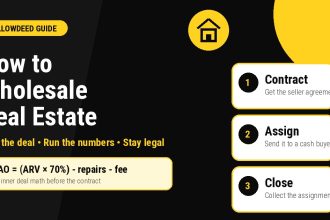
The critical formula is the 70% rule: your maximum allowable offer (MAO) should be no more than 70% of the after-repair value (ARV, the price the property will sell for once fixed up) minus repair costs. If the ARV is $300,000 and repairs cost $50,000, your MAO is $160,000.
Quick math on a flip:
| Line Item | Amount |
|---|---|
| ARV (after-repair value) | $300,000 |
| MAO (70% of ARV minus repairs) | $160,000 |
| Rehab cost | $50,000 |
| Holding costs (6 months of loan payments, utilities, insurance) | $12,000 |
| Closing costs (buying + selling) | $18,000 |
| Total cost | $240,000 |
| Gross profit | $60,000 |
That $60,000 sounds good until you factor in the 6 months of work, the stress of managing a rehab, and the risk that the ARV estimate was wrong. Flipping rewards precision and punishes optimism.
For the full playbook, see our fix-and-flip investor guide.
Wholesaling
You find a distressed property, put it under contract at a discount, and assign that contract to a cash buyer for a fee. You never own the property. You never do the rehab. You collect an assignment fee, typically $5,000 to $15,000 per deal.
Wholesaling requires almost no capital. What it does require is time, marketing effort, and sales skill. You need to find motivated sellers, negotiate contracts, and build a cash buyer list.
The process in five steps:
- Find a distressed or motivated seller (through driving for dollars, direct mail, cold calling, or networking).
- Negotiate a purchase contract at a price that leaves room for your fee and the end buyer’s profit.
- Market the contract to your cash buyer list.
- Assign the contract to the highest and best cash buyer.
- Collect your assignment fee at closing. You never own the property and never risk your own capital.
It is the fastest way to generate your first real estate income, but it is not passive and it is not easy. Most beginners need 3 to 6 months of consistent marketing before closing their first wholesale deal. The typical conversion rate from lead to closed deal is 2% to 5%, which means you need 20 to 50 qualified leads to close one deal.
Wholesaling is also the best education in real estate. You learn to find deals, negotiate with sellers, analyze properties, and build a buyer network. Those skills transfer directly to every other investing strategy.
For a step-by-step breakdown, read our wholesaling real estate guide.
BRRRR (Buy, Rehab, Rent, Refinance, Repeat)
BRRRR lets you recycle the same capital through multiple properties. You buy a distressed property with short-term financing (hard money or private money), rehab it, rent it out, then refinance into a long-term loan to pull your original capital back out.
If the deal is right, you recover 100% of your initial investment at the refinance. Then you do it again with the same money.
The risk is in the refinance. If the appraisal comes in low, you leave capital trapped in the deal. If rates rise between purchase and refinance, your cash flow shrinks.
BRRRR is powerful but unforgiving of sloppy math. Read our guide on the BRRRR strategy mistakes that kill deals before attempting your first one.
Creative Finance (Subject-To and Seller Financing)
Creative finance means structuring deals outside the traditional bank loan path. The two most common methods are subject-to and seller financing.
Subject-to means buying a property “subject to” the existing mortgage staying in place. You take ownership of the deed, but the seller’s loan remains. This lets you acquire property with little money down and lock in the seller’s (potentially lower) interest rate.
Seller financing means the seller acts as the bank. You negotiate a purchase price, interest rate, and payment schedule directly with the property owner. No bank involved. No income verification. No appraisal required in most cases.
Both strategies carry specific legal risks. Read our subject-to real estate guide and seller financing guide before pursuing either one.
How to Choose Your First Strategy
Your first strategy should match three things: your available capital, your available time, and your tolerance for risk. Here is the decision framework.
| Strategy | Capital Needed | Risk Level | Time Per Week | Typical First-Year Return | Best For |
|---|---|---|---|---|---|
| Buy and hold | $20,000 to $60,000 | Low to moderate | 2 to 5 hours | 8% to 12% cash-on-cash | Long-term wealth builders with steady income |
| Fix and flip | $30,000 to $100,000 | High | 15 to 30 hours | $30,000 to $80,000 per deal | Active investors who can manage projects |
| Wholesaling | $0 to $5,000 | Low (financial), high (time) | 20 to 40 hours | $5,000 to $15,000 per deal | Beginners with more hustle than capital |
| BRRRR | $20,000 to $50,000 | Moderate to high | 10 to 20 hours | Capital recycled, 10%+ CoC | Investors who want to scale fast |
| Creative finance | $2,000 to $10,000 | Moderate | 5 to 10 hours | Varies widely | Investors in high-rate environments |
If you have a full-time job and limited capital, start with wholesaling to build cash, then transition to buy-and-hold or BRRRR.
If you have $30,000 or more saved and want passive income, a buy-and-hold rental is the most straightforward first deal.
If you want to scale quickly and you are comfortable managing rehab projects, BRRRR lets you recycle capital without waiting years to save for the next down payment.
How to Analyze Your First Deal
Bad deals look good on the surface. Good deals reveal themselves in the math. Here are the four metrics you need to evaluate any investment property.
Net operating income (NOI). Gross rental income minus operating expenses (property taxes, insurance, property management, maintenance, vacancy allowance). NOI does not include your mortgage payment. If a property rents for $2,100/month and operating expenses total $700/month, your NOI is $1,400/month or $16,800/year.
Here is a quick NOI calculation for a typical single-family rental:
| Income / Expense | Monthly | Annual |
|---|---|---|
| Gross rent | $2,100 | $25,200 |
| Vacancy allowance (5%) | -$105 | -$1,260 |
| Property taxes | -$200 | -$2,400 |
| Insurance | -$120 | -$1,440 |
| Property management (8%) | -$168 | -$2,016 |
| Maintenance reserve (5%) | -$105 | -$1,260 |
| Net Operating Income | $1,402 | $16,824 |
Cap rate. NOI divided by the property’s current market value. A $200,000 property with $16,824 in annual NOI has a cap rate of 8.4%. Cap rate tells you what return you would earn if you paid all cash. It is useful for comparing properties but does not account for financing.
Cap rates vary widely by market and property type. A 5% cap rate in a coastal city and a 10% cap rate in a rural Midwest town can both be reasonable. The cap rate reflects the risk: lower cap rates mean lower risk (and lower returns), higher cap rates mean higher risk (and higher potential returns).
For the full breakdown, see our cap rate calculation guide.
Cash-on-cash return. Annual cash flow (NOI minus annual debt service) divided by total cash invested (down payment plus closing costs plus rehab). This is the metric that tells you what your actual money is earning.
Using the example above: if your annual debt service is $14,400 ($1,200/month mortgage) and your total cash invested was $55,000, your annual cash flow is $2,424. Your cash-on-cash return is 4.4%. Is that good enough? That depends on your market and your alternatives. A good target for a first deal is 8% to 12%.
The 1% rule. A quick screening filter: the monthly rent should be at least 1% of the purchase price. A $200,000 property should rent for at least $2,000/month. If it does not pass the 1% test, dig deeper before proceeding. It might still work, but the margins will be tighter.
The 1% rule works well in markets with lower property values ($100,000 to $250,000). In expensive coastal markets where homes cost $500,000 or more, almost nothing passes the 1% test. In those markets, investors rely on appreciation and equity buildup rather than pure cash flow.
The 50% rule. A rough estimate: half your gross rent will go to operating expenses (not including the mortgage). If rent is $2,100/month, expect around $1,050 in expenses. This is not precise, but it is a useful sanity check before running a full analysis.
For a deeper walkthrough of all eight metrics, read our guide on how to evaluate a rental property.
How to Finance Your First Investment
You have more financing options than you think. Here are the most common paths for first-time investors.
Conventional loan (20% to 25% down). The standard path. You need a 620+ credit score, verifiable income, and a DTI below 45%. Rates for investment properties run about 0.5% to 0.75% higher than primary residence rates. Freddie Mac’s Primary Mortgage Market Survey showed the 30-year fixed averaging near 6.5% for primary residences in early 2026; add the investment property premium and expect rates near 7% to 7.25%.
Conventional loans offer the lowest rates for investment properties, but they require full income documentation (W-2s, tax returns, pay stubs). Fannie Mae allows up to 10 financed properties per borrower. After 10, you need alternative financing (DSCR or portfolio loans).
Down payment breakdown by property type:
| Property Type | Minimum Down Payment |
|---|---|
| Single-family investment | 20% (one unit) |
| Duplex (investment, non-owner-occupied) | 25% |
| Triplex or fourplex (investment) | 25% |
| FHA house hack (owner-occupied) | 3.5% |
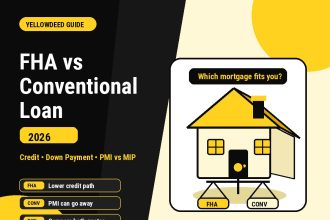
FHA loan (3.5% down, house hack only). FHA loans are for primary residences, but you can use one to buy a duplex, triplex, or fourplex. You live in one unit and rent out the others. The rent from the other units can cover most or all of your mortgage. This is the lowest-capital entry point into real estate investing. For a side-by-side comparison, read our FHA vs conventional loan breakdown.
If you are a first-time buyer considering the house hack route, our first-time home buyer guide walks through the full process from pre-approval to closing.
DSCR loan (no income docs, property qualifies itself). DSCR (debt service coverage ratio) loans qualify based on the property’s rental income, not your personal income. No W-2s, no tax returns. If the rent covers the mortgage by at least 1.0x to 1.25x, you qualify. Down payment is typically 20% to 25%. These are popular with self-employed investors and anyone scaling past the conventional 10-property limit.
Hard money loan (short-term, asset-based). Hard money lenders care about the deal, not your credit score. Rates are higher (10% to 14%) and terms are short (6 to 18 months). These are primarily used for fix-and-flip and BRRRR deals where you plan to sell or refinance quickly.
Private money (individual lenders). Borrowing from individuals (family, friends, networking contacts) at negotiated terms. Rates and terms vary. The key advantage is flexibility: no underwriting committee, no appraisal requirements, and terms you negotiate directly.
Seller financing. The seller carries the loan. You negotiate the rate, term, and down payment directly. This is creative finance at its most flexible. Read our seller financing guide for structuring details.
For the full breakdown of every loan type, see our real estate financing guide.
Worked Example: Two Scenarios With Real Numbers
Scenario A: $15,000 Starting Capital (BRRRR Approach)
You find a distressed single-family home in a B-class neighborhood in a Midwest market.
| Line Item | Amount |
|---|---|
| Purchase price (off-market, distressed) | $85,000 |
| Hard money loan (90% of purchase) | $76,500 |
| Your cash for down payment | $8,500 |
| Rehab budget | $25,000 |
| Hard money covers 100% of rehab | $25,000 |
| Total hard money loan | $101,500 |
| Your total cash in (down + closing + holding costs) | $14,500 |
| After-repair value (ARV) | $145,000 |
After rehab and tenant placement, you refinance into a conventional or DSCR loan at 75% LTV.
| Refinance Details | Amount |
|---|---|
| New loan amount (75% of $145,000 ARV) | $108,750 |
| Pay off hard money loan | $101,500 |
| Cash returned to you | $7,250 |
| Cash still in the deal | $7,250 |
| Monthly rent | $1,350 |
| Monthly PITIA (30-year, 7.25%) | $920 |
| Monthly cash flow (before management/maintenance) | $430 |
| Annual cash flow (with 8% management, 5% vacancy, 5% maintenance) | $2,840 |
| Cash-on-cash return | 39.0% |
You kept $7,250 in the deal and are earning $2,840/year in cash flow. Your remaining $7,250 in savings goes toward the next deal.
Scenario B: $50,000 Starting Capital (Buy-and-Hold Duplex)
You buy a duplex in a Sun Belt market using a conventional investment property loan.
| Line Item | Amount |
|---|---|
| Purchase price | $250,000 |
| Down payment (25%) | $62,500 |
| Closing costs (3%) | $7,500 |
| Total cash invested | $70,000 |
| Loan amount | $187,500 |
| Monthly PITIA (30-year, 7.0%) | $1,580 |
| Monthly rent (both units combined) | $2,600 |
| Vacancy allowance (5%) | -$130 |
| Property management (8%) | -$208 |
| Maintenance reserve (5%) | -$130 |
| Net monthly cash flow | $552 |
| Annual cash flow | $6,624 |
| Cash-on-cash return | 9.5% |
At 9.5% cash-on-cash, this deal outperforms the S&P 500’s long-term average while your tenants pay down the mortgage and the property appreciates. After 5 years at 3% annual appreciation, the duplex is worth roughly $290,000 and you have built approximately $30,000 in equity from mortgage paydown alone.
Building Your Investing Team
You do not need every team member before your first deal. But you do need at least three: a lender, an agent, and a contractor (if you are rehabbing). Build the rest as your portfolio grows.
Real estate agent (investor-friendly). Not every agent understands investment deals. Find one who works with investors, can run comps quickly, and understands cash flow analysis. Ask: “How many investment properties have you helped clients close in the last 12 months?” If the answer is fewer than five, keep looking. A good investor agent can also be a deal source, alerting you to properties before they hit the market.
Lender (or lenders). Get pre-approved before you start looking at deals. Ideally, have relationships with a conventional lender, a DSCR lender, and a hard money lender. Different deals need different financing. Interview at least three lenders before your first deal. Compare rates, terms, closing speed, and how responsive they are. A lender who takes 3 days to return your call will cost you deals.
Contractor. If you are doing any rehab (BRRRR, flip), you need a licensed, insured contractor with references. Get three bids on every project. Check their license on your state’s contractor licensing board. Ask for references from their last three jobs and call every one. A $5,000 difference in bids means nothing if the cheaper contractor disappears mid-project.
Property manager. If you are buying a rental, decide early whether you will self-manage or hire a manager. Management fees run 8% to 10% of collected rent plus a tenant placement fee (typically half to one full month’s rent for finding a new tenant). For your first property within driving distance, self-management is fine. For out-of-state or scaling past 3 to 4 units, hire a manager.
Interview property managers the same way you interview any service provider. Ask: What is your vacancy rate across your portfolio? How do you handle maintenance calls? What is your eviction process? How do you screen tenants? A good manager prevents problems. A bad one creates them.
CPA (real estate-specialized). A CPA who understands real estate tax strategy will save you more than their fee. They handle depreciation schedules, cost segregation studies, 1031 exchange compliance, and entity structuring. Ask specifically about their experience with real estate investors. A CPA who primarily handles small business taxes may miss real estate-specific deductions.
Real estate attorney. Needed for entity formation (LLC creation), contract review, and any creative finance deal (subject-to, seller financing, syndication). You do not need one on retainer, but you need one you can call. Find one through your local REIA chapter or ask your agent for a referral.
Common Beginner Mistakes That Cost Real Money
1. Skipping the math and buying on “gut feel.” Gut feel does not calculate cash flow. Run the numbers on every deal. If the math does not work at current rates and rents, walk away.
2. Underestimating rehab costs. New investors routinely underestimate rehab by 20% to 40%. A project you budget at $30,000 can easily hit $40,000 with scope changes, permit costs, and contractor delays. Add a 20% contingency to every rehab budget.
3. Ignoring vacancy. Assume 5% to 8% vacancy on annual projections, even in hot markets. A single month of vacancy on a $1,500/month rental costs you $1,500 plus utilities and lawn care.
4. Over-leveraging. Using maximum leverage on every property leaves no margin for error. One bad tenant or one major repair can create a cash flow crisis across your entire portfolio. Keep reserves of at least 6 months PITIA per property.
5. Choosing the wrong market. Investing in a declining market because prices are low is a trap. Low prices often mean low demand, high vacancy, and difficult tenant pools. Look at population growth, job growth, and rent-to-price ratios.
6. Neglecting due diligence. Skipping the inspection to save $400 can cost you $15,000 in foundation repairs you did not see. Always get a professional inspection on any property you plan to buy.
7. Not having an exit strategy. Before you buy, know how you will exit. Can you sell at a profit? Can you refinance if rates drop? Can you break even on rent if the market softens? If the answer to all three is no, the deal is too risky.
8. Trying to do everything alone. Real estate investing is a team sport. Trying to be your own agent, contractor, property manager, and accountant burns you out and costs more in mistakes than hiring professionals.
Choosing the Right Market
Where you invest matters as much as what you invest in. The best deal in a declining market still loses money.
Population growth. Markets where people are moving in (Austin, Raleigh, Tampa, Nashville, Phoenix) tend to see rising rents and rising values. Markets where people are leaving (small Rust Belt cities, some rural areas) carry higher vacancy risk. Check U.S. Census Bureau migration data for the numbers.
Job growth. Employment drives housing demand. Markets with diverse employers across multiple industries (healthcare, tech, government, logistics) are more stable than markets dependent on a single employer or industry.
Rent-to-price ratio. Divide the average monthly rent by the average home price in the market. If the ratio is 0.8% or higher, the market likely supports cash-flow positive investing. Below 0.6%, you are betting almost entirely on appreciation.
Landlord-friendliness. Some states make evictions fast and straightforward (Texas, Arizona, Indiana). Others have extensive tenant protections that slow the process to 6 months or more (California, New York, New Jersey). This does not mean you cannot invest in tenant-friendly states, but factor the eviction timeline into your risk model.
Out-of-state investing. You do not have to invest where you live. Many investors in expensive coastal markets buy properties in Midwest and Sun Belt markets where the numbers work. The trade-off is that you need a property manager and a reliable local team. Budget 8% to 10% of gross rent for management.
Real Estate Investing vs Stocks: 30-Year Comparison
Both real estate and stocks build wealth. They do it differently.
| Factor | Real Estate | S&P 500 Index |
|---|---|---|
| Average annual return (30 years) | 8% to 12% (including appreciation, cash flow, equity buildup) | 10.2% (S&P Global, price return plus dividends) |
| Leverage | 4:1 to 5:1 typical (20% to 25% down) | 1:1 (margin accounts exist but are risky) |
| Tax advantages | Depreciation, 1031 exchange, pass-through deduction, capital gains deferral | Long-term capital gains, tax-loss harvesting |
| Cash flow | Monthly rent income | Quarterly dividends (typically 1.5% to 2% yield) |
| Liquidity | Low (30 to 90 days to sell) | High (sell in seconds) |
| Control | High (you choose tenants, set rents, manage property) | None (you own shares, not decisions) |
| Volatility | Low to moderate (prices move slowly) | High (20%+ drawdowns happen regularly) |
| Effort required | Active (management, maintenance, tenant relations) | Passive (buy and hold) |
The real advantage of real estate is leverage. If you put $50,000 down on a $250,000 property and it appreciates 4% in year one, the property gained $10,000 in value. But your return on the $50,000 you invested is 20%, not 4%. Stocks do not offer this kind of leveraged upside without margin risk.
The advantage of stocks is liquidity and zero effort. You can sell an index fund in seconds. You cannot sell a rental property in seconds.
Most serious wealth builders hold both.
Tax Advantages of Real Estate Investing
Real estate offers tax benefits that no other asset class matches. These are the four big ones.
Depreciation. The IRS lets you deduct the cost of the building (not the land) over 27.5 years for residential property and 39 years for commercial. On a $200,000 property where the building is worth $160,000, your annual depreciation deduction is $5,818. That is a paper loss that offsets rental income, even if the property is actually appreciating. See IRS Publication 946 for the full depreciation rules.
1031 exchange. When you sell an investment property, you can defer all capital gains taxes by reinvesting the proceeds into another qualifying property within 180 days. There is no limit to how many times you can 1031 exchange. Some investors have deferred millions in capital gains over decades by never cashing out. The rules are specific; see IRS Section 1031 and use a qualified intermediary.
Pass-through deduction (Section 199A). If you own rental property through a pass-through entity (sole proprietorship, LLC, S-corp, or partnership), you may qualify for a 20% deduction on your qualified business income. On $30,000 in net rental income, that is a $6,000 deduction.
Mortgage interest deduction. The interest you pay on your investment property mortgage is fully deductible against rental income. On a $200,000 loan at 7%, you are paying roughly $14,000 in interest in year one. All of it is deductible.
How this plays out in practice. Suppose you own a rental property generating $24,000 in annual gross rent and $8,000 in net cash flow after expenses and mortgage payments. On paper, your taxable income from the property might be near zero or even negative, because depreciation ($5,818) and mortgage interest ($14,000) combine to create a paper loss. You are putting $8,000 in real cash in your pocket while reporting minimal or no taxable income to the IRS. That is the power of real estate tax strategy.
These four benefits combined can reduce your effective tax rate on real estate income to near zero in the early years of ownership. Consult a CPA who specializes in real estate to maximize your deductions.
Cost Segregation: The Accelerated Depreciation Strategy
Standard depreciation spreads the building’s value over 27.5 years. Cost segregation is an engineering study that reclassifies components of the property (appliances, flooring, landscaping, parking lots) into shorter depreciation schedules of 5, 7, or 15 years.
On a $300,000 property, a cost segregation study might allow you to take $40,000 to $60,000 in accelerated depreciation in year one instead of $5,818. The study costs $3,000 to $7,000, but the tax savings often exceed the cost by 5x to 10x.
Cost segregation makes the most sense for properties valued at $200,000 or more and for investors in higher tax brackets. Ask your CPA if it fits your situation.
Scaling Beyond Your First Deal
Your first deal is the hardest. It takes the most research, the most hesitation, and the most emotional energy. Deals two through five are faster because you have systems, relationships, and confidence.
Here is a typical scaling path:
Properties 1 to 3: Foundation. Buy and hold in your local market. Learn tenant screening, property management, and basic maintenance coordination. Self-manage to understand the business before you outsource.
Properties 4 to 10: Systems. Hire a property manager. Establish relationships with contractors and lenders. Start using BRRRR to recycle capital faster. This is where your team becomes critical.
Properties 10+: Scale. Move into DSCR loans (conventional lenders cap you at 10 financed properties through Fannie Mae). Consider multifamily (5+ units), syndication, or commercial property. Read our commercial real estate investing guide if this is your trajectory.
Properties 20+: Portfolio management. At this level, real estate is a business. You need entity structuring (LLCs for liability protection), portfolio-level insurance, a CPA who handles cost segregation studies, and possibly a bookkeeper or virtual assistant.
The timeline varies. Some investors reach 10 properties in 3 years using BRRRR. Others take a decade buying one property every 12 to 18 months. Both approaches build wealth. The right speed depends on your risk tolerance, your capital, and how much time you can commit.
Frequently asked questions
How much money do I need to start real estate investing?
It depends on your strategy. Wholesaling requires almost no capital ($0 to $5,000 for marketing). House hacking with an FHA loan requires 3.5% down (on a $200,000 duplex, that is $7,000). A conventional rental property requires 20% to 25% down. In a market where entry-level investment properties cost $150,000, that means $30,000 to $37,500 plus closing costs and reserves. Budget $40,000 to $50,000 total for your first conventional rental purchase.
Can I invest in real estate with no money?
You can wholesale deals, bird-dog for other investors, or partner with someone who has capital while you bring the deal and the work. True zero-dollar investing is possible through wholesaling and creative finance. But “no money” still requires time, effort, and marketing.
Is real estate investing risky?
All investing carries risk. Real estate-specific risks include vacancy, market downturns, unexpected repairs, bad tenants, and interest rate changes. The advantage of real estate is that you have more control over these risks than you do with stocks. You choose the market, the property, the tenants, and the financing. Good due diligence reduces risk significantly.
Should I invest in real estate or the stock market?
Both. They serve different purposes. Real estate provides cash flow, leverage, and tax advantages. Stocks provide liquidity and passive growth. Most wealthy individuals hold both asset classes. Start with whichever fits your capital and time availability.
What type of property is best for a first-time investor?
A single-family rental or a small multifamily (duplex or triplex) in a market with strong rent-to-price ratios. These are easier to finance, easier to manage, and easier to sell if you need to exit.
Do I need a real estate license to invest?
No. You need a license to represent other people in transactions (as an agent or broker), but not to buy, sell, or rent your own property. Some investors do get licensed for access to the MLS and commission savings, but it is not required.
What is house hacking?
House hacking means buying a multi-unit property (duplex, triplex, or fourplex), living in one unit, and renting out the others. You qualify for owner-occupied loan rates (lower) and use an FHA loan with 3.5% down. The rental income from the other units offsets your mortgage, and in many markets, covers it entirely.
How do I find my first investment property?
Start on the MLS through an investor-friendly agent. Also look at off-market channels: driving for dollars, direct mail, wholesaler lists, and networking at your local REIA chapter. The best deals are rarely listed publicly.
What is a good cash-on-cash return for a rental property?
A good target for a first deal is 8% to 12% cash-on-cash return. Some markets and strategies (like BRRRR) can produce 15% to 25% or higher, but they come with more risk and effort.
What are the tax benefits of real estate investing?
The major benefits are depreciation (a paper loss that offsets income), 1031 exchanges (defer capital gains by reinvesting), mortgage interest deductions, and the Section 199A pass-through deduction. Together, these can reduce your effective tax rate on real estate income to near zero in the early years.
Should I form an LLC for my rental property?
An LLC provides liability protection, separating your personal assets from your rental business. Most investors form an LLC before or shortly after acquiring their first property. The cost is typically $50 to $500 depending on your state. Consult a real estate attorney for entity structuring advice.
How long does it take to see returns from real estate?
Cash flow starts as soon as your first tenant moves in (typically 30 to 60 days after closing). Appreciation is a long-term play; you need 3 to 5 years minimum for meaningful appreciation gains. Tax benefits (depreciation deductions) apply starting in the first year of ownership. Most investors see their first positive returns within 60 to 90 days of closing on a well-analyzed rental property.
What is the best book for real estate investing beginners?
“The Book on Rental Property Investing” by Brandon Turner covers buy-and-hold fundamentals. “The Book on Estimating Rehab Costs” by J Scott is essential for flippers and BRRRR investors. Both are available through BiggerPockets. Read one book matched to your chosen strategy, then start analyzing real deals. Reading without action is procrastination.
Should I invest locally or out of state?
Start locally if your market supports cash-flow positive investing (rent-to-price ratio above 0.8%). If you live in a high-cost market where rentals do not cash flow (San Francisco, New York, Los Angeles), out-of-state investing in Midwest and Sun Belt markets is a proven alternative. You will need a local property manager, but the cash flow often more than covers the management fee.
What to Do This Week
You have the framework. Here is what to do with it in the next 7 days.
1. Run your financial readiness check. Check your credit score (free at annualcreditreport.com), calculate your DTI, and count your available capital. These three numbers determine which strategy is open to you right now.
2. Pick one strategy and go deep. Do not try to learn all five at once. Pick the one that matches your capital and time. If you have under $10,000, study wholesaling. If you have $20,000 or more, study buy-and-hold or BRRRR. Read the linked guides above for your chosen strategy.
3. Talk to a lender. Call a local bank, a mortgage broker, and a DSCR lender. Ask what you qualify for. Get a pre-approval letter. Knowing your buying power turns abstract planning into concrete deal analysis.
4. Attend one REIA meeting or join one online investor community. Your local Real Estate Investors Association meets monthly. BiggerPockets has active forums. Both are free. Surround yourself with people who are doing what you want to do. The right network accelerates everything.
Insurance and Entity Protection
Before you close on your first deal, set up two layers of protection.
Landlord insurance (required by your lender). Landlord insurance covers the building structure, liability, and loss of rent if the property becomes uninhabitable. It costs roughly 15% to 25% more than a standard homeowner’s policy. On a $200,000 property, expect $1,200 to $1,800 per year. Make sure the policy includes liability coverage of at least $500,000 per occurrence.
Umbrella insurance. An umbrella policy adds liability coverage above your landlord policy. A $1 million umbrella policy typically costs $200 to $400 per year. It protects your personal assets if a tenant or visitor sues for an amount exceeding your landlord policy limits.
LLC formation. Most investors form an LLC for each property or group of properties. The LLC separates your personal assets from your rental business. If a tenant sues, they can reach the assets inside the LLC but not your personal savings, your home, or your other investments. Formation costs range from $50 to $500 depending on your state.
One note on LLCs and financing: conventional lenders require the loan to be in your personal name, not the LLC. Many investors take the loan personally and then transfer the property into the LLC after closing. This technically triggers the due-on-sale clause, but in practice, lenders rarely call loans on performing residential properties that are transferred to a single-member LLC owned by the borrower. Discuss the specifics with your real estate attorney.
The best time to start was five years ago. The second best time is this week.