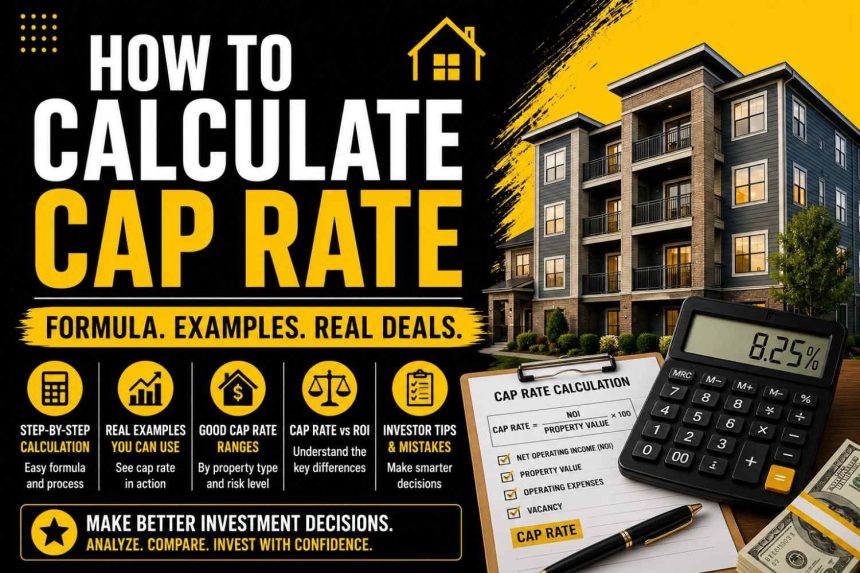
Learning how to calculate cap rate is one of the first steps in analyzing an investment property.
- What is cap rate?
- Cap rate formula
- Cap Rate = NOI ÷ Property Value × 100
- How to calculate cap rate step by step
- Step 1: Calculate gross rental income
- Step 2: Subtract vacancy and operating expenses to get NOI
- Step 3: Divide NOI by current market value
- What is not included in NOI?
- Cap rate does not include your mortgage.
- Cap rate calculation example
- Second example: lower cap rate property
- Deal comparison example: two properties side by side
- The highest cap rate is not always the best deal.
- What is a good cap rate?
- Higher vs lower cap rate: what they mean
- Factors that affect cap rate
- Location and neighborhood
- Asset class and property quality
- Interest rates and financing environment
- Lease term and tenant quality
- Property condition and age
- Cap rate compression and expansion
- Reverse cap rate formula: using cap rate to estimate property value
- Cap rate vs ROI
- Cap rate vs cash-on-cash return
- Cap rate vs IRR, GRM, and DCF
- Limitations of cap rate
- It is a single-period snapshot
- It does not include financing
- It does not include capital expenditures
- It can be misleading for unstabilized properties
- It depends on accurate NOI
- Common cap rate mistakes
- Using gross income instead of NOI
- Including the mortgage in operating expenses
- Ignoring vacancy
- Trusting seller expenses without checking
- Comparing different property types
- Ignoring property condition
- FAQs about cap rate
- What is a good cap rate for a rental property?
- Does cap rate include the mortgage?
- What does a 7.5% cap rate mean?
- Do cap rates rise with interest rates?
- Is a higher or lower cap rate better?
- How is cap rate different from ROI?
- Can I use cap rate for an unstabilized property?
- What factors affect cap rate?
- How does financing affect the cap rate formula?
- Our Conclusion
The cap rate, short for capitalization rate, helps investors compare the income potential of a property against its current market value. It is common in commercial real estate, multifamily investing, rental property analysis, and income-producing real estate valuation.
The formula is simple:
Cap Rate = Net Operating Income ÷ Current Market Value × 100
If a property produces $80,000 in annual net operating income and is worth $1,000,000, the cap rate is 8%.
That sounds easy. But the real work is not the division. The real work is calculating net operating income correctly, understanding what expenses are included, knowing what expenses are excluded, and reading the number in context.
A higher cap rate can mean stronger income compared with price, but it can also mean higher risk. A lower cap rate can mean a safer or more desirable asset, but it may also mean the property is expensive relative to its income.
This guide explains the cap rate formula in plain English, walks through real examples, compares cap rate vs ROI, shows what a good cap rate may look like, and explains when cap rate can mislead you.
If you haven’t yet decided which investing strategy fits your goals, our beginner’s guide to real estate investing covers buy-and-hold, BRRRR, flipping, wholesaling, and creative finance before you dive into the numbers.
What is cap rate?
Cap rate, or capitalization rate, is a real estate valuation metric that shows the annual income return of a property based on its net operating income and value.
In simple terms, cap rate answers this question:
If you bought the property in cash, what percentage return would the property generate from operations before financing?
The key phrase is before financing.
Cap rate does not include mortgage payments, debt service, loan terms, income taxes, depreciation, or capital expenditures. It focuses on the property’s income and operating expenses, not the investor’s personal financing structure.
That is why cap rate is useful for comparing two properties side by side. It removes the loan from the equation and shows how the asset performs on its own.
A duplex, apartment building, retail center, office building, warehouse, or small commercial real estate asset can all be analyzed using cap rate if the property produces income.
Check the cap rate before you chase the deal.
Enter the property’s annual income, vacancy, operating expenses, and market value. This calculator estimates NOI and cap rate using the standard formula.
Estimated cap rate
This cap rate may indicate a strong income yield, but compare it with location, tenant quality, property condition, and market risk.
Cap rate formula
The cap rate formula is:
Cap Rate = Net Operating Income ÷ Current Market Value × 100
You may also see it written as:
Capitalization Rate = NOI ÷ Property Value
Where:
NOI means net operating income.
Property value means current value, market value, or purchase price if you are analyzing a pending deal.
Cap rate is expressed as a percentage.
For example:
- Net operating income: $80,000
- Property value: $1,000,000
$80,000 ÷ $1,000,000 = 0.08
0.08 × 100 = 8%
So the property has an 8% cap rate.
Cap Rate = NOI ÷ Property Value × 100
Use annual net operating income, not monthly rent. Use current market value or purchase price, not your loan amount.
How to calculate cap rate step by step
To calculate cap rate correctly, follow three steps.
Step 1: Calculate gross rental income
Start with the property’s gross rental income. This is the total annual rent the property can produce before expenses.
If an apartment building has 10 units and each unit rents for $1,000 per month:
$1,000 × 10 units = $10,000 per month
$10,000 × 12 months = $120,000 annual gross rental income
This number may also be called gross income or gross potential income.
But do not stop here. A property may not collect every dollar of possible rent.
Step 2: Subtract vacancy and operating expenses to get NOI
Next, subtract vacancy loss and operating expenses.
Vacancy loss accounts for empty units, nonpayment, or downtime between tenants.
Operating expenses may include:
- Property taxes
- Insurance
- Property management
- Maintenance
- Repairs
- Utilities paid by owner
- Landscaping
- Trash
- Cleaning
- Legal and accounting
- Leasing costs
- HOA dues, where applicable
- Routine administrative expenses
The result is net operating income.
NOI = Gross Income − Vacancy Loss − Operating Expenses
If a property collects $120,000 in gross annual rent, has $6,000 in vacancy loss, and $34,000 in operating expenses:
$120,000 − $6,000 − $34,000 = $80,000 NOI
That $80,000 is the number you use in the cap rate formula.
Step 3: Divide NOI by current market value
Now divide net operating income by current value or purchase price.
If NOI is $80,000 and the property is listed at $1,000,000:
$80,000 ÷ $1,000,000 = 0.08
That equals an 8% cap rate.
Always express cap rate as a percentage. Investors usually say “8% cap,” not “0.08 cap.”
What is not included in NOI?
This is where many new investors make mistakes.
Net operating income includes normal property operations. It does not include the investor’s loan, taxes, or non-operating accounting items.
Do not include:
- Mortgage payments
- Debt service
- Income taxes
- Depreciation
- Capital expenditures
- Major renovations
- Loan fees
- Investor distributions
- Owner personal expenses
A roof replacement, HVAC replacement, major parking lot resurfacing, or large renovation is usually treated as CapEx, not a normal operating expense. These costs still matter, but they are not part of standard NOI in the cap rate calculation.
Cap rate does not include your mortgage.
Debt service
Income taxes
Depreciation
Capital expenditures
Cap rate calculation example
Let’s use a simple example.
You are evaluating a small apartment building listed for $1,000,000.
The seller provides the following numbers:
- Gross annual rent: $120,000
- Vacancy loss: $6,000
- Operating expenses: $34,000
- Purchase price: $1,000,000
First, calculate NOI:
$120,000 − $6,000 − $34,000 = $80,000
Then calculate cap rate:
$80,000 ÷ $1,000,000 = 0.08
The cap rate is 8%.
That means the property generates an 8% annual return on its value before financing, income taxes, depreciation, and major capital expenditures.
If you were buying the property all cash, the cap rate gives you a clean way to understand the property’s income yield. If you are using a loan, you still need to analyze cash flow after debt service.
Second example: lower cap rate property
Now look at a different property.
You are evaluating a stabilized retail property listed for $2,000,000.
The numbers are:
- Gross annual rental income: $180,000
- Vacancy loss: $5,000
- Operating expenses: $75,000
- Property value: $2,000,000
NOI is:
$180,000 − $5,000 − $75,000 = $100,000
Cap rate is:
$100,000 ÷ $2,000,000 = 0.05
The cap rate is 5%.
At first, the 8% apartment building may look better than the 5% retail property. But that is not always true.
The 5% property may have stronger tenants, longer lease terms, better location, newer building systems, lower maintenance needs, and more stable cash flow. The 8% property may need repairs, have higher vacancy, weaker tenants, or be in a less desirable neighborhood.
Cap rate gives you a starting point. It does not give you the whole answer.
Deal comparison example: two properties side by side
A strong way to use cap rate is to compare two properties in the same market or asset class.
| Metric | Property A | Property B |
|---|---|---|
| Purchase price | $1,000,000 | $1,000,000 |
| Gross income | $120,000 | $105,000 |
| Vacancy | $6,000 | $3,000 |
| Operating expenses | $34,000 | $27,000 |
| NOI | $80,000 | $75,000 |
| Cap rate | 8.0% | 7.5% |
Property A has the higher cap rate. It also has higher income, but it has more vacancy and higher operating expenses.
Property B has a slightly lower cap rate but may be more stable if it has better tenants, lower maintenance, and stronger rent collection.
Now add context:
- Property A is older and needs roof work soon.
- Property B was renovated recently.
- Property A has short-term leases.
- Property B has reliable tenants and stronger lease terms.
In that case, Property B may be the safer investment even though the cap rate is lower.
This is why investors should not chase the highest cap rate blindly.
The highest cap rate is not always the best deal.
Compare the cap rate with location, tenant quality, lease term, building condition, vacancy risk, and future repairs before choosing a property.
What is a good cap rate?
There is no single good cap rate for every investment property.
A good cap rate depends on:
- Location
- Asset class
- Tenant quality
- Lease length
- Property condition
- Interest rates
- Market growth
- Risk level
- Investor goals
- Financing environment
In general, lower-risk properties tend to trade at lower cap rates. Higher-risk properties tend to trade at higher cap rates.
A high-quality multifamily property in a strong neighborhood may have a lower cap rate because investors see it as stable. A Class C office building with vacancy problems may have a higher cap rate because buyers demand more return for more risk.
A “good” cap rate is not just a number. It is a number compared with the risk.
General cap rate ranges by property type
These are broad, simplified ranges. Real market cap rates vary by city, submarket, interest rates, tenant quality, and property condition.
| Property type | Possible cap rate behavior |
|---|---|
| Stabilized multifamily | Often lower because demand is easier to understand |
| Industrial | Often lower in strong logistics markets |
| Retail | Varies widely by tenant quality and location |
| Office | Can be higher where vacancy or demand risk is elevated |
| Older rental property | May show higher cap rate if risk or repairs are higher |
| Newer stabilized asset | May show lower cap rate due to perceived safety |
The point is not to memorize one perfect range. The point is to compare similar properties in the same market.
An 8% cap rate may be attractive in one city and suspicious in another. A 5% cap rate may be normal for a high-quality asset in a strong market and too low for an older property with flat rents.
Higher vs lower cap rate: what they mean
A higher cap rate usually means the property generates more NOI compared with its value. This can look attractive because the income yield is higher.
But a higher cap rate may also signal:
- Higher vacancy risk
- Weaker location
- Older property condition
- Shorter leases
- Lower tenant quality
- Higher maintenance needs
- Slower appreciation
- Harder financing
- Less investor demand
A lower cap rate usually means investors are willing to pay more for each dollar of NOI.
That may happen because the property has:
- Strong location
- High tenant demand
- Better building condition
- Long-term leases
- High-credit tenants
- Lower vacancy
- Better growth expectations
- Lower perceived risk
Neither is automatically better.
A conservative investor may prefer a lower cap rate property with stable tenants. A value-add investor may prefer a higher cap rate property where they can improve NOI through renovations, better property management, rent increases, or lower vacancy.
Factors that affect cap rate
Cap rate changes with the market, the property, and investor expectations.
Location and neighborhood
Location is one of the biggest factors that affect cap rate.
Properties in strong neighborhoods, job-rich cities, growing suburbs, or supply-constrained markets often trade at lower cap rates. Investors accept lower income yield because they expect stability, rent growth, or appreciation.
Properties in weaker locations often need higher cap rates to attract buyers.
Asset class and property quality
Different asset classes carry different risk.
Multifamily, retail, industrial, office, self-storage, and mixed-use real estate do not behave the same way.
A newer industrial property leased to a strong tenant may have a lower cap rate than an older office building with uncertain demand. A well-located apartment building may trade differently from a small retail strip center with local tenants.
Property quality also matters. A newer building with strong systems usually deserves a different valuation than an older property with deferred maintenance.
Interest rates and financing environment
Interest rates affect cap rates because they affect investor return expectations and borrowing costs.
When interest rates rise, investors may demand higher cap rates to compensate for higher financing costs and alternative investment options. When rates fall, cap rates may compress because cheaper debt can support higher property values.
This is not automatic in every market, but the relationship matters.
Lease term and tenant quality
A property leased to strong tenants on long leases may trade at a lower cap rate than a property with short leases or unstable tenants.
Tenant quality matters more in commercial real estate. A national tenant with strong credit is different from a small business with uncertain revenue.
For multifamily, tenant risk is spread across many units. For a single-tenant retail property, one vacancy can mean 100% income loss.
Property condition and age
Older properties may show higher cap rates because buyers expect more repairs.
A high cap rate can disappear quickly if the property needs a new roof, plumbing upgrades, electrical work, HVAC replacement, parking lot repairs, or major interior renovations.
That is why cap rate should always be reviewed with property condition.
Cap rate compression and expansion
Cap rate compression happens when cap rates move lower. This usually increases property values if NOI stays the same.
Cap rate expansion happens when cap rates move higher. This usually decreases property values if NOI stays the same.
Example:
A property has $100,000 in NOI.
At a 5% cap rate:
$100,000 ÷ 0.05 = $2,000,000 value
At a 6% cap rate:
$100,000 ÷ 0.06 = $1,666,667 value
Same NOI. Different cap rate. Lower value.
This is why exit cap rate assumptions matter. If you buy at a 5% cap rate and plan to sell at a 5% cap rate, your return may look strong. But if the market moves and buyers demand 6.5%, your sale value may be lower than expected.
Reverse cap rate formula: using cap rate to estimate property value
You can also use cap rate to estimate value.
The reverse formula is:
Property Value = NOI ÷ Cap Rate
If a property has $90,000 in NOI and similar properties in the market trade around a 6% cap rate:
$90,000 ÷ 0.06 = $1,500,000
That means the estimated value is $1.5 million.
This is useful when:
- Testing a seller’s asking price
- Estimating resale value
- Comparing offers
- Underwriting a refinance
- Evaluating a market’s valuation range
But the cap rate you use must match the asset. Do not use a downtown Class A multifamily cap rate to value an older suburban retail building.
Cap rate vs ROI
Cap rate and return on investment are related, but they are not the same.
Cap rate measures the property’s income return based on NOI and value, before financing.
ROI measures the investor’s return based on money invested and total gain. ROI may include financing, appreciation, sale proceeds, tax effects, and improvements.
Cap rate example
NOI: $80,000
Property value: $1,000,000
Cap rate = 8%
ROI example
You invest $250,000 cash into the deal. After debt service and expenses, you receive $20,000 in annual cash flow.
$20,000 ÷ $250,000 = 8% cash-on-cash return
That is not the same as cap rate.
The cap rate is based on the property’s unlevered operating income. Cash-on-cash return is based on your actual cash invested and financing structure.
Cap rate vs cash-on-cash return
Cash-on-cash return is often more useful when you are using a mortgage.
It measures:
Annual cash flow after debt service ÷ Cash invested
If a property has an 8% cap rate but the loan is expensive, the cash-on-cash return may be lower.
Example:
- NOI: $80,000
- Annual debt service: $60,000
- Cash flow after debt service: $20,000
- Cash invested: $250,000
Cash-on-cash return:
$20,000 ÷ $250,000 = 8%
If debt service rises to $72,000, cash flow drops to $8,000.
$8,000 ÷ $250,000 = 3.2%
The cap rate did not change, but the investor’s cash return changed because financing changed.
Cap rate vs IRR, GRM, and DCF
Cap rate is only one metric. Investors often use it with other tools.
Internal Rate of Return
Internal Rate of Return, or IRR, estimates the annualized return over the full hold period. It includes timing of cash flows, refinance proceeds, and sale proceeds.
IRR can be useful for larger investment decisions, but it depends heavily on assumptions.
Gross Rent Multiplier
Gross Rent Multiplier, or GRM, compares property price to gross rental income.
GRM = Property Price ÷ Gross Rental Income
It is quick, but less precise than cap rate because it does not include operating expenses.
Discounted Cash Flow
Discounted cash flow, or DCF, estimates property value by discounting future cash flows back to today. It can account for time value of money, rent growth, sale value, and multiple years of performance.
DCF is more detailed than cap rate, but it also requires more assumptions.
Cap rate is best for a quick income-based snapshot. DCF is better for deeper long-term analysis.
Limitations of cap rate
Cap rate is useful, but it has limits.
It is a single-period snapshot
Cap rate usually looks at one year of NOI. It does not show future rent growth, lease rollover, major repairs, or changes in expenses.
A property may show a strong cap rate today but have leases expiring next year.
It does not include financing
Cap rate ignores the mortgage. This helps compare properties, but it does not show your actual cash flow after loan payments.
A property can have a decent cap rate and still produce weak cash flow if debt service is high.
It does not include capital expenditures
Cap rate may ignore major repairs. A property with an 8% cap rate but $200,000 in upcoming repairs may not be as attractive as it looks.
It can be misleading for unstabilized properties
Cap rate works best for stabilized income-producing property.
For an unstabilized property with major vacancy, renovation plans, or incomplete income, the current cap rate may not reflect the future business plan.
In that case, investors may use pro forma cap rate, yield on cost, DCF, or other tools. But pro forma numbers should be treated carefully because they are projections, not current performance.
It depends on accurate NOI
Bad inputs create bad outputs.
If the seller understates expenses or overstates rental income, the cap rate will look better than reality.
Always verify:
- Rent roll
- Lease terms
- Actual collected rent
- Property taxes
- Insurance
- Repairs and maintenance
- Management fees
- Utilities
- Vacancy history
- Capital needs
Common cap rate mistakes
Using gross income instead of NOI
Cap rate uses net operating income, not gross rental income.
If you divide gross rent by value, you are not calculating cap rate.
Including the mortgage in operating expenses
Debt service is not part of NOI. Mortgage payments affect cash flow, not the cap rate formula.
Ignoring vacancy
A property is rarely 100% occupied forever. Vacancy matters, especially in rental property and multifamily analysis.
Trusting seller expenses without checking
Seller-provided expenses may be incomplete. Always confirm property taxes, insurance, utilities, maintenance, and management costs.
Comparing different property types
Do not compare a stabilized industrial property to an older office building and assume the higher cap rate is better. Asset class matters.
Ignoring property condition
A high cap rate can hide deferred maintenance. Always inspect the property and budget for repairs.
FAQs about cap rate
What is a good cap rate for a rental property?
A good cap rate for a rental property depends on location, property condition, tenant quality, rent growth, and risk. A higher cap rate may mean stronger income yield, but it may also mean more risk. Compare similar properties in the same market instead of using one universal number.
Does cap rate include the mortgage?
No. Cap rate does not include mortgage payments or debt service. The formula uses net operating income divided by current market value. Mortgage payments are used when calculating cash flow or cash-on-cash return.
What does a 7.5% cap rate mean?
A 7.5% cap rate means the property’s annual net operating income equals 7.5% of the property’s value. For example, if a property is worth $1,000,000 and has a 7.5% cap rate, the NOI is $75,000.
Do cap rates rise with interest rates?
Cap rates can rise when interest rates rise because investors may demand higher returns and borrowing becomes more expensive. But cap rates also depend on location, asset class, rent growth, tenant quality, and investor demand.
Is a higher or lower cap rate better?
Neither is automatically better. A higher cap rate may offer more income but more risk. A lower cap rate may signal a stronger location, better tenants, or lower risk. The right cap rate depends on the investor’s strategy.
How is cap rate different from ROI?
Cap rate measures a property’s income return before financing. ROI measures the investor’s return and may include financing, cash invested, sale proceeds, appreciation, and other gains.
Can I use cap rate for an unstabilized property?
You can, but be careful. Current cap rate may not be useful if the property has major vacancy, renovations, or incomplete income. In that case, use pro forma cap rate, yield on cost, DCF, and conservative assumptions.
What factors affect cap rate?
Factors that affect cap rate include location, asset class, property condition, tenant quality, lease term, vacancy risk, interest rates, market demand, and expected rent growth.
How does financing affect the cap rate formula?
Financing does not affect the cap rate formula directly because cap rate excludes debt service. Financing affects cash flow, cash-on-cash return, risk, and investor return, but not the property’s unlevered cap rate.
Our Conclusion
Cap rate is one of the most useful real estate investing metrics because it gives investors a quick way to compare income-producing properties.
But it is not magic.
The formula is simple:
Cap Rate = NOI ÷ Property Value × 100
The judgment behind it is harder.
You need accurate rental income, realistic vacancy, true operating expenses, and a clear understanding of what NOI excludes. You also need to compare the number against location, asset class, property condition, tenant quality, interest rates, and risk.
A high cap rate can be attractive. It can also be a warning. A low cap rate can look expensive. It can also reflect a high-quality asset with stable income.
Use cap rate as a starting point, not the final decision. Then check cash flow, debt service, cash-on-cash return, repairs, lease terms, and exit value.
A smart investor does not ask, “Is the cap rate high?”
A smart investor asks, “Is this cap rate fair for the risk I am taking?”