The Best Deals Never Hit the MLS
According to the National Association of Realtors (NAR), roughly 10% of all residential sales in 2025 closed without ever being listed on the MLS. For investor-to-investor transactions, that figure jumps closer to 25%.
- The Best Deals Never Hit the MLS
- What Is an Off-Market Deal (and Why Chase One)?
- Method 1: Driving for Dollars
- Method 2: Direct Mail Campaigns
- Method 3: Skip Tracing and Cold Calling
- Method 4: Bandit Signs and Door Knocking
- Method 5: Networking Your Way to Deals
- Method 6: PropStream and Data-Driven List Building
- Method 7: Court Records and Probate Leads
- Method 8: Building Relationships With Agents Who Work Distressed Sellers
- How to Finance Off-Market Purchases
- How to Evaluate an Off-Market Deal Once You Find One
- Off-Market Deal Funnel: From Lead to Contract
- Common Mistakes That Waste Your Marketing Budget
- Frequently asked questions
- Your First Off-Market Campaign
By the time a property shows up on Zillow, Redfin, or Realtor.com, 30 other investors in your market already know about it. Your inbox fills with the same automated alerts as theirs. And when the bidding war starts, you end up paying retail for a property that was supposed to be an investment.
Here’s the thing. If you want to make money consistently in 2026, stop competing on listed properties. They are sourcing off-market deals where there is no bidding war, no agent commissions eating into margins, and no rush to outbid a cash buyer from out of state.
This guide covers eight methods to build your own off-market pipeline. Some cost money. Some cost time. All of them work when you are consistent.
Key takeaways
- Off-market deals mean less competition and better margins because you negotiate before a property ever hits the MLS.
- Eight methods work: driving for dollars, direct mail, skip tracing and cold calling, bandit signs and door knocking, networking, data-driven lists like PropStream, court and probate records, and agent relationships.
- Consistency beats cleverness. Direct mail and cold calling convert after repeated touches, not the first contact.
- Build your lists around motivation signals: absentee owners, high equity, long ownership, pre-foreclosure, tax delinquency, and code violations.
- Treat off-market as a funnel. Track leads, contacts, appointments, and offers so you know which method actually produces deals.
What Is an Off-Market Deal (and Why Chase One)?
An off-market deal is any property transaction where the seller has not listed the property on the Multiple Listing Service (MLS). The property might be for sale, the owner might be open to selling, or the owner might not even know they want to sell yet.
That last category is where the real opportunity lives.
The Margin Advantage
ATTOM Data Solutions reported in Q4 2025 that the average gross profit on a fix-and-flip was $72,000, or roughly 27.5% return on investment. But flippers who sourced off-market reported gross margins 12-18% higher than those who bought listed properties, largely because they avoided bidding wars and often negotiated seller-paid concessions.
When you buy off-market, the math shifts in your favor in three ways:
- Less competition. You are often the only offer on the table, not one of seven.
- Lower purchase price. Sellers who haven’t listed are typically motivated by speed, convenience, or distress, not top-dollar price.
- More creative deal structures. Off-market sellers are more open to owner financing, subject-to deals, lease options, and other terms that don’t fly on a listed property with an agent involved.
Who Sells Off-Market?
Not every off-market seller is desperate. The profile varies:
- Absentee owners tired of managing a rental from 800 miles away
- Inherited properties where the executor has no interest in maintaining the home
- Pre-foreclosure owners who want to sell before the bank takes over
- Landlords with problem tenants who want out of the headache
- Divorcing couples who need a clean break, fast
- Elderly owners moving to assisted living
Each of these seller types responds to different outreach methods. The eight methods below cover all of them.
Method 1: Driving for Dollars
Driving for dollars is exactly what it sounds like. You drive through target neighborhoods, identify distressed or vacant properties by their physical condition, and record the address for follow-up.
You are looking for signs of distress: overgrown lawns, boarded windows, code violation stickers, piled-up mail, peeling paint, or a roof with visible damage. These are properties where the owner has stopped investing in upkeep, which often signals willingness to sell at a discount.
How to Do It
- Pick 3-5 target neighborhoods based on your buy criteria (price range, school district, proximity to your other properties).
- Drive every street. Look at every house. Don’t skip blocks.
- Log every distressed property. Use an app (more on that below) or a simple spreadsheet with address, condition notes, and a photo.
- Run the owner through a skip trace to find their phone number and mailing address.
- Make contact within 48 hours while your notes are fresh.
The DealMachine Advantage
DealMachine is the most popular driving-for-dollars app in 2026. You photograph a property, and the app pulls the owner’s name, mailing address, and estimated equity from county records. It also sends direct mail for you if you want to automate the follow-up.
Cost: $49-99/month depending on your plan, plus $0.60-1.50 per mail piece if you use the built-in direct mail feature.
Conversion Numbers
Plan on this: for every 100 distressed properties you log, roughly 60-70 will have trackable owners. Of those, 5-10 will engage in a conversation. And 1-3 will result in a deal.
That 1-3% conversion rate might sound low. But a single off-market deal can net you $30,000-80,000 in profit. At $100/month for the app plus your gas and time, the ROI is hard to beat.
Method 2: Direct Mail Campaigns
Direct mail is old-school. It also still works. The NAR’s 2025 Member Profile found that direct mail was the second most common lead source for investor transactions, behind only referrals.
Building Your List
Your mailing list is the most important part of the campaign. A beautiful postcard sent to the wrong list is a waste of money. The right list sent an ugly postcard still produces leads.
Sources for your mailing list:
- PropStream or BatchLeads for absentee owners, pre-foreclosure, and tax-delinquent lists (covered in detail under Method 6)
- County tax records (free, but slow to compile)
- ListSource or DataTree for filtered owner data
- Your own driving-for-dollars list from Method 1
What to Send
You have two choices that actually work:
Handwritten-style letters. Yellow letter in a hand-addressed envelope. The open rate is 80%+ because it looks like personal mail. Cost: $1.50-2.50 per piece including postage.
Postcards. Cheaper ($0.50-0.80 per piece), but lower response rates. Best for high-volume campaigns where you want to touch 1,000+ addresses per month.
Response Rates and Cost Per Lead
Here is the realistic math:
- Response rate on a well-targeted list: 0.5-2%
- Cost per mail piece (postcard): $0.60-0.80
- Cost per mail piece (yellow letter): $1.50-2.50
If you send 1,000 yellow letters at $2.00 each, you spend $2,000. At a 1% response rate, you get 10 calls. If 2 of those become deals, your cost per deal is $1,000.
The key word there is “well-targeted.” Sending to a random list of owner-occupants will get you a 0.1% response rate and a lot of angry voicemails.
Consistency Beats Creativity
One mailing won’t work. The data on direct mail is clear: response rates double or triple on the third and fourth touch. Plan for at least 5-7 mailings to the same list over 3-4 months before you evaluate results.
Method 3: Skip Tracing and Cold Calling
Skip tracing means finding a property owner’s phone number and current address using public records, data aggregators, and proprietary databases. Once you have their number, you call them.
Cold calling is not glamorous. It is also the fastest way to generate conversations with motivated sellers, sometimes within hours of starting.
Tools
- PropStream ($99/month) includes skip tracing credits and list building
- BatchLeads ($79-199/month) offers bulk skip tracing at $0.12-0.15 per record
- Skip Genie for standalone skip tracing at $0.08-0.10 per hit
The Numbers
Expect this from a cold calling campaign:
- Dials per hour: 15-25 (manual) or 40-60 (with a dialer like Mojo or BatchDialer)
- Contact rate: 8-12% (meaning you reach a live person)
- Leads per 100 contacts: 3-5 warm leads
- Deals per 100 warm leads: 5-10
That means roughly 1 deal per 200-400 dials. If you make 50 dials a day, you should close 1 deal every 4-8 weeks. Faster if your list is tight.
Cold Call Script: Absentee Owner
Keep it short. You are not selling anything on the phone. You are finding out if they would consider an offer.
“Hi, is this [Owner Name]? My name is [Your Name], I’m a local real estate investor. I noticed you own a property at [Address]. I’m looking to buy homes in that area, and I was wondering if you’ve considered selling, or if you’d be open to hearing an offer? No pressure either way.”
If they say no, thank them and move on. If they say “maybe” or “what would you offer?”, you have a lead. Set an appointment to see the property.
Cold Call Script: Pre-Foreclosure
This call requires more care. The owner is in financial distress, so lead with empathy, not opportunity.
“Hi, is this [Owner Name]? My name is [Your Name]. I work with property owners in the area who may be dealing with a tough situation on their mortgage. I’m not a lender or a debt collector. I buy properties directly, and I might be able to help you avoid foreclosure. Would you have a few minutes to talk about your options?”
Never mention the specific foreclosure filing on the first call. Let them bring it up. Your goal is a conversation, not a confrontation.
Method 4: Bandit Signs and Door Knocking
Bandit Signs
You have seen them. “We Buy Houses” signs stuck in the ground at busy intersections. They look cheap. They work.
A 2024 survey by the National Real Estate Investors Association (NREIA) found that bandit signs still produce leads at $3-8 per call in most markets, making them one of the cheapest lead sources available.
Cost: $1-3 per sign (corrugated plastic, ordered in bulk). You need 50-100 signs per campaign.
The catch: Many cities and counties have banned them. Check your local ordinances before you plant a single sign. Fines can run $50-500 per sign, per day. In some markets, the risk is worth it. In others, it’s a fast way to burn money.
Door Knocking
Door knocking is cold calling in person. It is harder, more uncomfortable, and produces higher-quality leads than almost any other method.
When you knock on a distressed property’s door, you bypass every filter. No mailbox. No voicemail. No spam call blocker. You are face-to-face with the owner, and that personal interaction builds trust faster than any mail piece or phone call.
How to do it effectively:
- Dress casually but neatly. You are a neighbor, not a salesperson.
- Bring a simple one-page flyer with your name, phone number, and a clear statement: “I buy houses in this neighborhood. Cash. Any condition. Quick close.”
- Visit Saturday mornings between 10am and 1pm. That’s when people are home and awake.
- If nobody answers, leave the flyer with a handwritten note: “Sorry I missed you. I’d love to chat about your property when you have a minute.”
Conversion: Expect 1 lead for every 30-50 doors you knock. That’s better than direct mail, but it costs you time instead of money.
Method 5: Networking Your Way to Deals
The most reliable source of off-market deals over a 12-month period is not any single marketing tactic. It is your network.
Investors who consistently close off-market deals know people who know people. They have spent months (sometimes years) becoming the person others think of when someone says, “I know a guy who wants to sell his house.”
Where to Build Your Network
REIA Meetings (Real Estate Investor Associations). Every major metro has one. Most meet monthly. Attend consistently for 6 months, and you will know every serious investor, wholesaler, and bird dog in your market.
BiggerPockets. The largest online real estate investor community. The forums are a goldmine for market-specific advice, partnership opportunities, and deal flow. Focus on your local market subforum.
Facebook Groups. Search for “[Your City] Real Estate Investors” or “[Your City] Wholesale Deals.” These groups are noisy, but deals do get posted there, especially from new wholesalers trying to build a buyer’s list.
Local Meetups. Smaller than REIA meetings, often more actionable. Look for groups focused on a specific strategy (fix-and-flip, BRRRR, multifamily).
How to Become the Person Who Gets Calls
- Be a reliable buyer. Close when you say you will close. Follow through on every commitment. Word travels fast in a local investor community.
- Tell everyone your buy criteria. “I buy single-family homes in [zip codes], $100-300K, any condition, can close in 14 days.” The more specific you are, the more memorable you are.
- Bring value first. Share a contractor contact. Forward a lead you can’t use. Help someone analyze a deal. This is how real relationships form.
- Stay in touch. A monthly text or email to your network keeps you top of mind. “Hey, still buying in [area]. Let me know if anything comes across your desk.”
Over time, this network becomes your most valuable asset. It costs nothing but consistency.
Method 6: PropStream and Data-Driven List Building
Data-driven list building is the most scalable off-market method. Instead of driving streets or attending meetings, you use software to filter property records and identify owners who match your motivated seller profile.
PropStream is the most widely used platform. Here is a step-by-step walkthrough for building your first list:
- Set your target area. Choose a zip code or county.
- Apply filters. Start with: absentee owner + high equity (50%+ equity) + owned 10+ years. This identifies owners who live somewhere else, have significant equity, and have held the property long enough to consider selling.
- Refine with distress indicators. Add pre-foreclosure, tax delinquent, or code violation filters to narrow to the most motivated sellers.
- Export and skip trace. PropStream includes built-in skip tracing. Export the list with phone numbers and mailing addresses.
- Launch outreach. Feed the list into your direct mail, cold calling, or text messaging campaign.
Other list types worth pulling:
| List Type | Why They Sell |
|---|---|
| Absentee owners with high equity | Tired landlords, inherited properties |
| Pre-foreclosure (lis pendens filed) | Facing foreclosure, need fast sale |
| Tax delinquent | Behind on taxes, may lose property |
| Vacant properties | Not generating income, costing money |
| Probate | Inherited property, heirs want cash |
| Divorce filings | Court-ordered property division |
| Code violations | City pressure to fix or sell |
Stack two or more filters for the highest-quality leads. An absentee owner who is also tax delinquent is far more motivated than an absentee owner with no financial pressure.
Method 7: Court Records and Probate Leads
Probate leads come from properties inherited by heirs who may not want to keep them. When someone passes away and leaves real estate, the property goes through probate court. The executor (the person appointed to settle the estate) often wants to sell the property quickly to distribute cash to the heirs.
How to find probate leads:
- Visit your county courthouse or check the county court website for probate filings. Many counties publish probate records online.
- Identify cases where real property is listed as an estate asset.
- Find the executor’s contact information (name and address are public record in the probate filing).
- Send a letter expressing interest in purchasing the property. Do not cold call probate leads unless local customs and regulations support it. A respectful letter is the standard approach.
Timing matters. The executor typically cannot sell property until the court grants Letters Testamentary (authority to act on behalf of the estate). This can take 30 to 90 days after the probate filing. Reach out during this window so you are top of mind when they are ready to sell.
Ethics note. Probate sellers are often grieving. Be respectful, patient, and transparent. Do not pressure. Do not use language that implies urgency. Your pitch is: “I understand this is a difficult time. If and when you are ready to sell the property, I can make the process straightforward and handle it on your timeline.”
Probate deals often sell at 10% to 25% below market because the heirs want cash, not a renovation project or a rental to manage.
Method 8: Building Relationships With Agents Who Work Distressed Sellers
Not all off-market deals bypass agents entirely. Some real estate agents specialize in working with distressed sellers (pre-foreclosure, divorce, probate, relocation) and can bring you deals before they hit the MLS.
How to position yourself as a reliable cash buyer:
- Provide proof of funds. A bank statement or a lender letter showing you can close. Agents will not bring you deals if they doubt your ability to perform.
- Close when you say you will. Follow through on every commitment. If you say you will close in 21 days, close in 21 days. Agents remember investors who perform and blacklist ones who do not.
- Pay a fair price. Agents work for commission. If your offers are consistently too low, they will stop calling. Off-market does not mean “lowball.” It means “fair price for a fast, certain close.”
- Communicate consistently. Return calls quickly. Provide updates during due diligence. Make the agent’s job easier and they will bring you the next deal first.
Build relationships with 3 to 5 agents in your target market. Reach out by phone, attend open houses, or ask for introductions through your REIA chapter.
The agent relationship advantage: Unlike every other method on this list, agent-sourced deals come pre-vetted. The agent has already confirmed the seller’s motivation, seen the property, and often has an asking price in mind. Your job is to evaluate the deal, not generate the lead. This makes agent-sourced deals the most time-efficient channel, even if the prices are slightly higher than fully direct-to-seller deals.
How to Finance Off-Market Purchases
Finding the deal is half the equation. Closing it requires the right financing, and off-market deals often require faster closings than conventional loans allow.
Cash. The fastest close (7 to 14 days). If you have the capital, a cash offer gives you the strongest negotiating position. Many motivated sellers will accept a lower price for the certainty of a cash close.
Hard money loans. Asset-based loans that fund in 7 to 14 days. Rates run 10% to 14% with 1 to 3 points. These are designed for short-term deals: flips and BRRRR projects where you plan to sell or refinance within 6 to 12 months. The lender cares about the deal (the ARV and the repair budget), not your income or credit score.
Private money. Borrowing from individuals at negotiated terms. If you have relationships with people who want passive returns on their capital, private money can fund deals at rates below hard money (8% to 12%) with more flexible terms.
DSCR loans. If you are buying a rental property that already has tenants (or will be rented immediately), a DSCR loan qualifies based on the property’s rental income. Closing takes 21 to 30 days. No income documentation required.
Conventional loans. The lowest rates but the slowest close (30 to 45 days) and the most paperwork. Not ideal for competitive off-market situations where the seller wants speed.
For the full breakdown of every financing option, see our real estate financing guide.
How to Evaluate an Off-Market Deal Once You Find One
Finding the deal is step one. Evaluating it correctly is what keeps you profitable. Here is the quick math.
Step 1: Estimate the ARV. ARV (after-repair value) is what the property will be worth after renovations. Pull 3 to 5 comparable sales within 0.5 miles that sold in the last 90 days. Adjust for differences in square footage, bedrooms, bathrooms, and condition. If comps show $180,000 to $200,000, use the lower end ($180,000) for a conservative estimate.
Step 2: Estimate repairs. Walk the property or get a contractor bid. For a rough estimate, use per-square-foot pricing: light cosmetic rehab runs $15 to $25/sqft, medium rehab (kitchen and bath updates, flooring, paint) runs $25 to $45/sqft, and heavy rehab (structural, roof, HVAC, plumbing) runs $45 to $75/sqft.
Step 3: Calculate your maximum allowable offer (MAO).
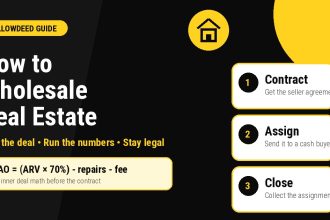
The 70% rule: MAO = ARV x 0.70 minus repair costs.
Worked example:
| Item | Amount |
|---|---|
| ARV (conservative estimate) | $180,000 |
| 70% of ARV | $126,000 |
| Estimated repair costs | $30,000 |
| MAO (maximum you should offer) | $96,000 |
| Potential gross profit if flipping | $54,000 |
| Holding costs (4 months) | -$6,000 |
| Closing costs (buy + sell) | -$12,000 |
| Net profit | $36,000 |
If you are buying this as a BRRRR deal, the math changes. Your goal is to refinance at 75% of ARV ($135,000) and pull back as much of your initial capital as possible.
For rental deals, run the cap rate and cash-on-cash return calculations to confirm the property cash flows after the rehab is complete.
A note on repair estimates. Until you have experience, get a contractor bid before making an offer on any property that needs more than cosmetic work. Beginners routinely underestimate rehab costs by 20% to 40%. A contractor walkthrough costs nothing (most contractors will bid for free hoping to win the job) and prevents you from locking in a deal that eats your profit in unexpected repairs.
If you cannot get a contractor to the property before making an offer (common in competitive off-market situations), use the per-square-foot ranges above and add a 25% contingency. A property you estimate at $30,000 in repairs should be budgeted at $37,500 until you have a real bid.
For financing options on off-market purchases, see our real estate financing guide.
Off-Market Deal Funnel: From Lead to Contract
Every off-market method feeds into the same funnel. Here are the typical conversion rates at each stage.
| Stage | Conversion Rate | Example (starting with 1,000 leads) |
|---|---|---|
| Leads generated (addresses/contacts) | 100% | 1,000 |
| Contact made (phone, mail response, door) | 10% to 20% | 100 to 200 |
| Interested in selling | 20% to 30% of contacts | 20 to 60 |
| Appointment set | 50% of interested | 10 to 30 |
| Offer made | 80% of appointments | 8 to 24 |
| Offer accepted | 20% to 30% of offers | 2 to 7 |
That gives you roughly 2 to 7 deals per 1,000 leads. At an average assignment fee or equity spread of $15,000 to $25,000 per deal, the math works if your cost per lead stays below $5 to $10.
The key insight: this is a volume business. You will not close every lead, every appointment, or every offer. Consistency beats intensity. Marketing every week for 6 months outperforms a single massive campaign.
Common Mistakes That Waste Your Marketing Budget
1. Mailing once and quitting. Most sellers need 3 to 7 touches before responding. If you mail a list once and move on, you wasted the first mailing. Commit to at least 5 rounds of follow-up over 6 months.
2. Targeting the wrong list. A list of owner-occupants with low equity and no distress indicators will produce almost zero motivated sellers. Stack your filters: absentee + high equity + tax delinquent produces far better results than absentee alone.
3. Using a generic message. “We buy houses” postcards are so common that many sellers throw them away automatically. Personalize your outreach. Reference the specific property address. Use a handwritten-style letter. Stand out.
4. Not answering the phone. If your marketing generates calls and nobody picks up, you are throwing money away. Motivated sellers call one investor. If you do not answer, they call the next postcard in the pile. Use a dedicated phone line and answer during business hours, or use a virtual answering service.
5. Offering too low on every deal. Extremely aggressive offers signal that you are not serious. A fair offer that closes beats a lowball offer that insults the seller and kills the deal. Leave room for profit, but do not leave the seller feeling taken advantage of.
6. Skipping follow-up. The biggest deals often come from the 90-day follow-up call. The seller who said “not yet” in January might be ready in April because their situation changed. Set a follow-up schedule and stick to it.
7. Not tracking metrics. If you do not know your cost per lead, cost per deal, and conversion rates at each funnel stage, you cannot optimize. Track everything from day one.
Frequently asked questions
What is an off-market real estate deal?
An off-market deal is a property sale that happens without the property being listed on the MLS. You connect with the seller directly through marketing, networking, or outreach rather than through a public listing.
Are off-market deals legal?
Yes. There is nothing illegal about buying a property directly from a seller without using the MLS. Both parties agree to a price and close through a title company, the same as any other real estate transaction. Some states have specific disclosure requirements for wholesaling; check your state laws.
How much does it cost to find off-market deals?
Marketing costs vary by method. Driving for dollars runs $150 to $400/month. Direct mail costs $500 to $1,500 per mailing. Cold calling can be done for free (your time) or outsourced for $3 to $8 per hour. PropStream subscriptions run $99/month. Budget $500 to $2,000/month for a multi-channel campaign.
How long does it take to close an off-market deal?
From initial lead to closed deal, expect 30 to 90 days. The timeline depends on the seller’s motivation, the financing method (cash closes in 7 to 14 days, hard money in 14 to 21 days, conventional in 30 to 45 days), and how quickly you can complete due diligence.
What is driving for dollars?
Driving for dollars means physically driving through neighborhoods looking for properties that show signs of distress (overgrown lawns, deferred maintenance, vacant appearance). You record the address, skip trace the owner’s contact information, and reach out directly.
What is skip tracing?
Skip tracing is the process of finding a property owner’s contact information (phone number, email, mailing address) using their name and property address. Platforms like PropStream and BatchLeads automate this process for $0.10 to $0.25 per record.
Do I need a real estate license to buy off-market deals?
No. You do not need a license to buy property for your own investment. However, some states require a license if you are wholesaling (assigning contracts without taking ownership). Check your state’s real estate commission website for the current rules.
What is the best off-market lead source for beginners?
Driving for dollars is the cheapest starting point. It costs almost nothing beyond gas and a smartphone. If you have a marketing budget of $500 or more per month, direct mail to a skip-traced absentee owner list is the most proven channel.
How do I know if a seller is truly motivated?
Motivated sellers have a reason to sell quickly: financial distress (pre-foreclosure, tax liens), life events (divorce, death in the family, job relocation), or property burden (tired landlord, vacant property costing money). Ask open-ended questions about their situation. If they are not in a hurry, they are not a motivated seller.
Can I find off-market deals without spending money?
Yes. Door knocking, networking at REIA meetings, and checking public court records (probate, foreclosure) are all free. Cold calling is free if you use your own phone. These methods cost time instead of money, which is the right trade-off if you are starting with limited capital.
What is the difference between off-market and pocket listings?
A pocket listing is a property that an agent markets privately to a select group of potential buyers before (or instead of) putting it on the MLS. The agent is still involved and earns a commission. A true off-market deal has no agent involvement and connects you directly with the seller. Both bypass public MLS competition, but pocket listings typically sell closer to market value because the agent protects the seller’s interests.
How do I build a cash buyer list for wholesaling off-market deals?
Attend REIA meetings and collect contact info from active investors. Search county records for recent cash purchases (these are your cash buyers). Post on BiggerPockets and local Facebook investor groups. When you find a deal, email your list with the property address, ARV, repair estimate, and your asking price. A strong buyer list of 20 to 50 active cash buyers in your market is enough to move most wholesale deals within 48 to 72 hours.
Should I use texting or ringless voicemail to reach sellers?
Both can work, but both come with compliance risks. The Telephone Consumer Protection Act (TCPA) regulates unsolicited text messages and pre-recorded voicemails. Violations can result in fines of $500 to $1,500 per message. If you use these channels, consult with an attorney familiar with TCPA regulations in your state. Direct mail and live phone calls carry less regulatory risk.
Your First Off-Market Campaign
You have eight methods. Do not try all eight at once. Pick one or two and execute consistently for 90 days before adding another channel.
Week 1: Choose your target market (zip code or neighborhood). Pull a list of 500 absentee owners with high equity using PropStream or county assessor records. Skip trace the list.
Week 2: Send your first direct mail piece (handwritten-style yellow letter) to all 500. Set up a dedicated phone number with a voicemail greeting that identifies you as a property buyer.
Week 3: Start cold calling the same list. Make 50 to 100 calls per day. Track every conversation in a simple spreadsheet: name, phone number, property address, motivation level (hot, warm, cold), follow-up date.
Week 4 and beyond: Mail the same list again. Follow up with warm leads by phone. Drive your target neighborhood once a week and add new properties to your pipeline.
The first deal takes the longest. Most investors who commit to consistent marketing close their first off-market deal within 60 to 120 days. After that, the pipeline produces deals every month.
Start with one zip code, one list, and one outreach method. Scale after the first deal proves the system works.
Before you launch your first campaign, make sure you’ve locked in your strategy and numbers. Revisit our guide to starting real estate investing to confirm your approach.