Fix and flip real estate means buying a property below its repaired value, renovating it, and selling it for a profit. The basic profit formula is simple:
- What is fix and flip real estate?
- How does fix and flip work?
- Is fix and flip profitable in 2026?
- The fix and flip math: ARV, the 70% Rule, and MAO
- Fix and flip example: a $50,000 profit project
- How to finance a fix and flip
- The 8-step fix and flip playbook
- Step 1: Pick your market
- Step 2: Line up financing before you find a deal
- Step 3: Find distressed properties
- Step 4: Run the numbers
- Step 5: Negotiate and close the purchase
- Step 6: Manage the renovation
- Step 7: Stage and list the property
- Step 8: Close the sale and calculate net profit
- Scope of work: what to renovate and what to skip
- Common fix and flip mistakes that kill profit
- Fix and flip vs buy-and-hold vs BRRRR vs wholesaling
- Tax implications for fix and flip investors
- Pros and cons of flipping houses
- Should first-time flippers start with a small project?
- FAQs
- Is fix and flip real estate profitable in 2026?
- How much money do you need to start fix and flipping?
- What is the 70% Rule in fix and flip?
- How much profit can you make on a typical flip?
- How long does a fix and flip take?
- Can you finance a fix and flip with no money down?
- What is the difference between fix and flip and BRRRR?
- Do you need a real estate license to flip houses?
- How are flip profits taxed?
- Can you use a 1031 exchange on a flip?
- What is the biggest mistake first-time flippers make?
- Which states are active for fix and flip in 2026?
- Bottom line
Sale price – purchase price – repair costs – holding costs – closing costs = net profit
That formula is where most new flippers get humbled. The TV version makes flipping look like a design project. In real life, it is a math project with contractors, lender deadlines, surprise repairs, and buyers who compare your finished house against every other listing in the neighborhood.
The one formula every flipper should know before making an offer is the 70% Rule:
Maximum Allowable Offer = (ARV x 0.70) – repair costs
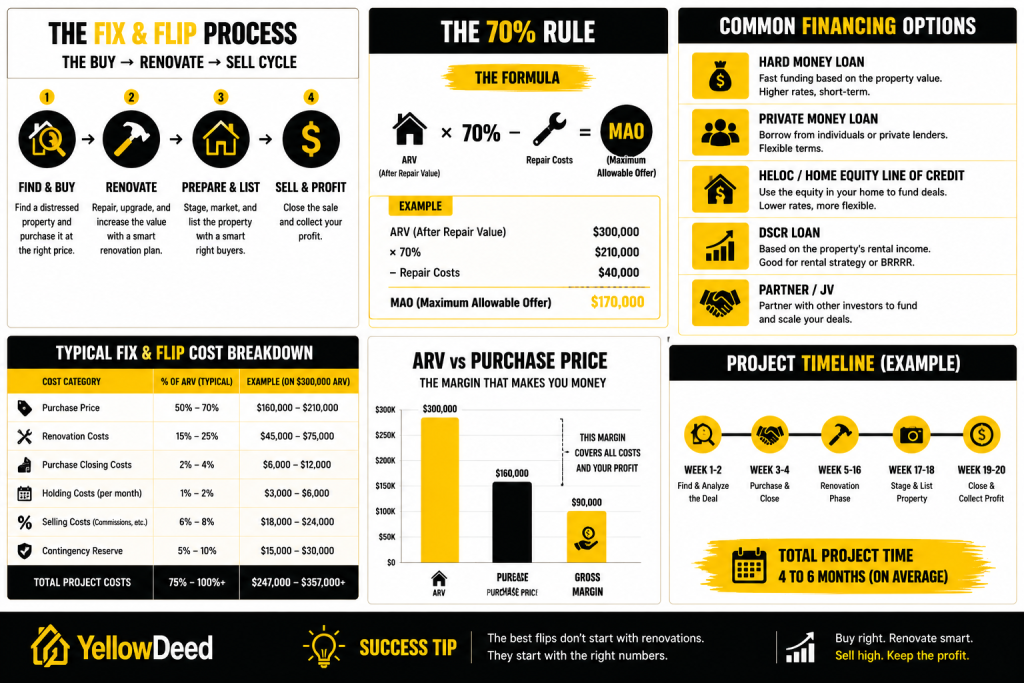
If the After Repair Value is $300,000 and the repairs are $40,000, your Maximum Allowable Offer is $170,000.
MAO = ($300,000 x 0.70) – $40,000
MAO = $210,000 – $40,000
MAO = $170,000
That 30% spread is not all profit. It has to cover closing costs, agent commissions, loan interest, insurance, taxes, utilities, mistakes, and your profit. Pay too much at purchase and the whole project gets tight before the first contractor shows up.
What is fix and flip real estate?
Fix and flip real estate is a short term investment strategy where an investor buys a distressed property, improves it, and sells it for more than the total cost of acquisition, renovation, financing, and sale.
A fix and flip project usually has three stages:
| Stage | What happens |
|---|---|
| Acquisition | You find and buy the property at a discount |
| Renovation | You repair and improve the property |
| Sale | You list, sell, and calculate net profit |
A good flip starts with the purchase price, not the paint color. You make money when you buy because the discount gives you room for repairs and resale costs. The renovation only protects or improves the margin you already created.
A bad flip often looks exciting at first. Big house. Nice neighborhood. Huge ARV. Then the roof needs replacement, the buyer asks for credits, the market slows, and the lender interest keeps stacking up.
That is why experienced flippers are usually more boring than beginners. They care about comps, permits, contractor bids, days on market, and exit price. The design matters, but the numbers decide the deal.
How does fix and flip work?
Most fix and flip projects follow the same path.
First, the investor finds a distressed property. It may be outdated, vacant, damaged, inherited, bank-owned, or owned by a seller who wants a quick sale. The property may come from the MLS, a wholesaler, a foreclosure auction, direct mail, a real estate agent, or a driving for dollars list.
Second, the investor estimates the ARV, repair costs, closing costs, holding costs, and resale timeline. This is where the project becomes real. A house that looks like a $60,000 profit flip may become a $12,000 profit flip once you add financing, taxes, utilities, commissions, and overruns.
Third, the investor buys the property, often with a hard money loan, private money loan, bridge loan, HELOC, business line of credit, or cash.
Fourth, the investor renovates the property. This can mean cosmetic work like paint, flooring, fixtures, and landscaping. It can also mean heavy repairs like roof, HVAC, plumbing, electrical, foundation, windows, and structural work.
Fifth, the investor lists the property, usually with a real estate agent, and sells it to an owner occupant or another buyer.
The final number that matters is not gross profit. It is net profit after every cost.
Is fix and flip profitable in 2026?
Fix and flip real estate can still be profitable, but the easy-margin era is gone in many markets.
ATTOM’s 2025 year-end U.S. Home Flipping Report found that 297,045 single-family homes and condos were flipped nationwide in 2025, the lowest annual total since 2020. Flipped homes made up 7.4% of all home sales, and the typical flipped home produced $65,981 in gross profit with a 25.5% return on investment, the lowest ROI ATTOM recorded since 2008.
That number is gross profit, not net profit. It does not mean the average flipper took home $65,981 after lender fees, agent commissions, insurance, taxes, utilities, repair overruns, staging, and closing costs.
The fourth quarter of 2025 looked even tighter. ATTOM reported 68,999 flipped homes in Q4 2025, representing 7.2% of all sales, with a typical gross ROI of 23.6%, the lowest level since Q3 2007. Georgia had the highest state flipping rate that quarter, followed by Ohio, Texas, and Utah.
So, is fix and flip profitable in 2026? Yes, but not by accident.
It works best when you have:
- A discounted purchase price
- Accurate ARV comps
- A real renovation budget
- Reliable contractors
- Enough cash reserves
- A market with buyer demand
- A clear exit plan before closing
It gets risky when you are over-leveraged, guessing on repairs, buying in a slow neighborhood, or assuming every project will sell fast.
The fix and flip math: ARV, the 70% Rule, and MAO
The math starts with ARV.
ARV, or After Repair Value, is what the property should sell for after the renovation is complete. You estimate ARV by studying comparable sales, not active listings. Sold comps are proof. Listings are just hopes.
Good comps are usually:
- Within 0.5 to 1 mile
- Sold in the last 3 to 6 months
- Similar in square footage
- Similar in bedroom and bathroom count
- Similar in age, lot size, and condition after repairs
- In the same school zone or neighborhood pocket when possible
Once you have ARV, estimate repair costs. This is where first-time flippers usually miss. They see cabinets and flooring but forget the less exciting stuff: roof, HVAC, plumbing, electrical, permits, pest damage, foundation, sewer lines, windows, water damage, and code issues.
Then calculate MAO.
MAO means Maximum Allowable Offer. It is the highest price you can pay and still leave enough margin.
The 70% Rule:
MAO = (ARV x 0.70) – repair costs
Example:
ARV: $300,000
Repair costs: $40,000
MAO = ($300,000 x 0.70) – $40,000
MAO = $170,000
In a hot market, some investors may use 75%. In a soft market, they may use 65%. The rule is a filter, not a law. The point is to stop yourself from falling in love with a deal that does not have enough spread.
Here is a fuller version of the cost stack:
| Cost | Example |
|---|---|
| Purchase price | $160,000 |
| Renovation costs | $52,000 |
| Purchase closing costs | $4,000 |
| Holding costs | $9,000 |
| Selling costs | $21,350 |
| Loan interest and fees | Included in holding/payoff |
| Sale price | $305,000 |
Net profit is not sale price minus purchase price. That shortcut gets people in trouble.
Fix and flip example: a $50,000 profit project
Say you find a distressed 3-bedroom, 2-bath single-family home. Comparable sales suggest an ARV of $300,000.
The repair scope includes the kitchen, both bathrooms, paint, flooring, and an HVAC tune-up. You estimate the rehab budget at $45,000.
Using the 70% Rule:
MAO = ($300,000 x 0.70) – $45,000
MAO = $210,000 – $45,000
MAO = $165,000
You buy the property for $160,000 with a hard money loan at 10% interest, a 12-month term, and 20% down.
Your acquisition costs:
| Item | Amount |
|---|---|
| Down payment | $32,000 |
| Purchase closing costs | $4,000 |
| Cash needed at purchase | $36,000 |
The renovation runs over budget. That happens. Instead of $45,000, you spend $52,000.
You hold the property for 5 months. Loan interest, property taxes, insurance, utilities, lawn care, and other carrying costs total about $9,000.
You list at $310,000. The home sells in 21 days for $305,000.
Selling costs:
| Item | Amount |
|---|---|
| Agent commission at 6% | $18,300 |
| Seller closing costs at 1% | $3,050 |
| Total selling costs | $21,350 |
Loan payoff, including principal and accrued interest, is about $133,000.
Now calculate the net:
Sale price: $305,000
Minus loan payoff: $133,000
Minus down payment and purchase closing: $36,000
Minus rehab: $52,000
Minus holding costs: $9,000
Minus selling costs: $21,350
Estimated net profit: $53,650
Cash deployed was roughly $97,000, including down payment, purchase closing costs, rehab, and holding costs. That is about a 55% cash-on-cash return in 5 months.
Nice deal. But notice the cushion. If the property sold for $285,000 instead of $305,000, or if repairs hit $70,000, the return would look very different.
How to finance a fix and flip
Most fix and flip investors do not use regular owner-occupied mortgage financing. The property may not qualify, the timeline may be too slow, or the lender may not like the condition.
Common financing options include:
| Financing option | How it works | Best fit |
|---|---|---|
| Hard money loan | Short term loan based heavily on the property and ARV | Fast purchases and distressed properties |
| Private money loan | Money from individuals or private lenders | Relationship-based funding |
| HELOC | Borrow against equity in your own home | Homeowners with equity and risk tolerance |
| DSCR loan | Loan based on rental income potential | Rental pivot, not a standard flip exit |
| Bridge loan | Short term loan to bridge purchase, rehab, or resale | Temporary funding gaps |
| Conventional investor loan | Traditional mortgage for investors | Slower deals, stronger borrowers |
| Line of credit | Business or personal credit line | Smaller repairs or gap funding |
| Partner or joint venture | One partner funds, another operates | New flippers with limited capital |
Hard money is common because it can close faster than a conventional loan. Rates vary, but Rocket Mortgage says hard money rates often fall between 8% and 12% and can be higher depending on lender terms, property type, market, and loan-to-value ratio.
Some fix-and-flip lenders advertise lower starting rates and longer term options. For example, Kiavi’s fix-and-flip terms currently advertise rates as low as 7.75%, loan sizes from $100,000 to $5 million, and 12, 18, and 24 month terms with interest-only options.
Do not choose financing only by rate. Look at:
- Origination points
- Draw process for rehab funds
- Inspection fees
- Prepayment penalties
- Extension fees
- Minimum credit score
- Experience requirements
- Cash reserve requirements
- Whether the lender funds repairs upfront or reimburses later
A cheap loan with a terrible draw process can stall your renovation. A fast loan with high points can eat your profit if the spread is thin.
The 8-step fix and flip playbook
Step 1: Pick your market
A good flip market is not always the hottest market. You want a place where buyers exist, renovation costs are predictable, and the resale price leaves room after expenses.
Look at:
- Median sale price
- Days on market
- Job growth
- Population trends
- School districts
- Property taxes
- Insurance costs
- Permit timelines
- Buyer demand by price range
- Inventory of outdated homes
A $900,000 flip can look exciting, but a small pricing mistake can be expensive. Many first-time flippers are better off with entry-level or mid-market homes where buyer demand is broader.
Step 2: Line up financing before you find a deal
Do this before making offers.
A seller, wholesaler, agent, or auction platform will not wait while you casually shop lenders. You need to know your buying power, down payment, proof of funds, rate, points, closing speed, and rehab funding structure.
Ask the lender these questions:
- What is the maximum loan-to-cost?
- What is the maximum loan-to-ARV?
- Do you fund rehab?
- How do draws work?
- What credit score do you require?
- Do you lend to first-time flippers?
- What cash reserves do you require?
- What are the extension terms if the project runs long?
Financing is part of the deal math. Treat it that way.
Step 3: Find distressed properties
Most good flip deals come from some kind of distress. That does not always mean foreclosure. It can mean the property is outdated, the owner is tired, the estate wants to sell, the landlord has bad tenants, or the seller does not want to repair the home before listing.
Deal sources include:
| Source | What to watch |
|---|---|
| MLS | Expired listings, price reductions, fixer-uppers |
| Wholesalers | Fast deal flow, but verify every number |
| Auctions | Potential discounts, higher risk |
| REO properties | Bank-owned homes |
| Pre-foreclosure lists | Owners behind on payments |
| Direct mail | Absentee owners, tired landlords |
| Driving for dollars | Vacant and neglected homes |
| Probate listings | Inherited properties |
| Real estate agents | Agents who understand investor math |
Wholesalers can be a strong source for experienced flippers, but do your own underwriting. A wholesaler’s ARV is not your ARV. Their repair estimate is not your contractor bid.
Step 4: Run the numbers
Before you make an offer, estimate:
- ARV
- Purchase price
- Repair costs
- Purchase closing costs
- Holding costs
- Financing costs
- Agent commission
- Seller closing costs
- Contingency reserve
- Expected sale price
- Net profit
- ROI
Add a repair buffer. A 10% to 20% contingency is not dramatic. It is normal.
If the only way the deal works is if everything goes perfectly, it is not a good beginner project.
Step 5: Negotiate and close the purchase
When you negotiate, stay anchored to the math. Sellers do not care about your MAO formula, but you should.
Your offer should reflect:
- Current condition
- Comparable sales
- Repair scope
- Timeline
- Closing certainty
- Seller motivation
- Your financing costs
Before closing, order a title search and title insurance where appropriate. Review liens, unpaid property taxes, code violations, HOA issues, open permits, and ownership problems. A cheap property with a messy title can burn weeks before you even start renovation.
Step 6: Manage the renovation
This is where the profit gets protected or destroyed.
Start with a written scope of work. Do not rely on “make it look nice.” That phrase is how budgets drift.
Your scope should list:
- Demolition
- Framing
- Roof
- HVAC
- Electrical
- Plumbing
- Kitchen
- Bathrooms
- Paint
- Flooring
- Fixtures
- Landscaping
- Final cleaning
- Punch list
Use a general contractor if the project is large or if you do not have the time and experience to manage subs. For smaller cosmetic projects, some investors manage individual trades themselves.
Get permits when required. Skipping permits can delay resale, create buyer concerns, or cause issues during inspection.
Step 7: Stage and list the property
A finished flip has to compete with normal retail listings. Buyers do not care that the renovation was stressful. They care about price, layout, condition, photos, and how the home feels compared with other options.
Professional staging can help, especially in higher price points or awkward layouts. At minimum, use professional photos, strong lighting, clean landscaping, and a clear pricing strategy.
Watch days on market. If homes in your price range are selling in 14 days and your listing has no serious activity after 21 days, the market is telling you something.
Step 8: Close the sale and calculate net profit
After the buyer is under contract, keep managing the deal. Inspection requests, appraisal issues, lender delays, and title problems can still show up.
Once the sale closes, calculate the real result:
Net profit = sale price – loan payoff – rehab costs – holding costs – closing costs – selling costs – all other project expenses
Then compare your projected numbers to actual numbers. That review is where you get better.
Track:
- Original ARV vs actual sale price
- Original repair estimate vs actual rehab cost
- Planned timeline vs actual timeline
- Projected profit vs net profit
- Mistakes to avoid next time
Every flip teaches you something. Some lessons are just more expensive than others.
Scope of work: what to renovate and what to skip
The best renovation is not the fanciest renovation. It is the renovation that matches the neighborhood and buyer expectations.
| Category | Typical range | Flip logic |
|---|---|---|
| Kitchen | $15,000 to $40,000 | Strong buyer impact, but avoid overbuilding |
| Bathroom | $8,000 to $20,000 each | Good ROI when outdated or damaged |
| Paint | Varies | High visual impact per dollar |
| Flooring | Varies | Makes the whole home feel cleaner |
| Fixtures | Low to moderate | Easy way to modernize |
| Curb appeal | Low to moderate | Helps photos and first impressions |
| Roof, HVAC, electrical, plumbing | As needed | Not glamorous, but buyers and inspectors care |
Skip upgrades that exceed neighborhood comps. A luxury kitchen in a starter-home neighborhood is usually not smart. A pool addition rarely makes sense for a flip unless the market specifically supports it. High-end finishes can also backfire if the buyer pool is price-sensitive.
Spend where buyers notice and inspectors care. Avoid ego renovations.
Common fix and flip mistakes that kill profit
The first mistake is paying too much. Almost every other mistake gets worse when the purchase price is too high.
The second mistake is trusting optimistic ARV. If you use the best comp in the neighborhood and ignore the average ones, you are not underwriting. You are daydreaming.
The third mistake is underestimating renovation costs. First-time flippers often price materials but forget labor, permits, trash removal, utility deposits, inspections, theft, change orders, and rework.
The fourth mistake is hiring the cheapest contractor without checking references, insurance, licenses, and recent projects. Cheap gets expensive when the work has to be redone.
The fifth mistake is starting work without a written scope. Contractors need specifics. So do you.
The sixth mistake is ignoring holding costs. Every extra month costs money through loan interest, insurance, taxes, utilities, lawn care, and opportunity cost.
The seventh mistake is over-renovating. Buyers pay based on neighborhood comps, not your personal taste.
The eighth mistake is having no backup exit. If the resale market cools, can you rent it? Refinance it? Sell at a lower price and still survive? If the answer is no, the deal needs more margin.
Fix and flip vs buy-and-hold vs BRRRR vs wholesaling
These strategies overlap, but they are not the same.
| Strategy | Main goal | Cash needed | Timeline | Main risk |
|---|---|---|---|---|
| Fix and flip | Buy, renovate, sell | Moderate to high | 5 to 7 months often | Cost overruns and resale risk |
| Buy-and-hold | Buy and rent | Moderate to high | Long term | Tenant, repair, and market risk |
| BRRRR | Buy, rehab, rent, refinance, repeat | High execution need | Medium to long term | Refinance risk |
| Wholesaling | Contract and assign deals | Low to moderate | Days to weeks | No buyer or bad contract |
| DST | Passive real estate exposure | High | Long term | Illiquidity and sponsor risk |
Fix and flip is active income. You run a project and sell. Buy-and-hold is more about long-term cash flow and appreciation. BRRRR is a hybrid because you renovate, rent, refinance, and keep the property. Wholesaling is deal sourcing and contract assignment.
A beginner with little cash may start with wholesaling. A beginner with more capital, contractor access, and time may try a small cosmetic flip. A long-term investor may prefer BRRRR or buy-and-hold.
For a full comparison of all five strategies — including how much capital each requires — see our complete guide to starting real estate investing.
Tax implications for fix and flip investors
This section matters more than most beginner guides admit.
A flip held for less than one year may create short-term capital gain, and the IRS says net short-term capital gains are taxed as ordinary income at graduated tax rates. For taxable years beginning in 2025, the IRS lists long-term capital gain rates of 0%, 15%, and 20% depending on taxable income, but short-term gains do not get that same preferred treatment.
Frequent flippers may also run into dealer status. In plain English, if you are buying properties mainly to renovate and resell to customers, the IRS may treat the activity more like a business selling inventory than a passive investment. That can affect whether income is reported as business income and whether self-employment tax issues come into play.
A 1031 exchange is usually not available for flip inventory. The IRS says Section 1031 applies to real property held for investment or productive use in a trade or business, and property held primarily for sale does not qualify.
There is one related concept people confuse with flipping: the Section 121 primary residence exclusion. If you sell your main home and meet the ownership and use tests, the IRS says you may be able to exclude up to $250,000 of gain, or up to $500,000 for married couples filing jointly. That generally requires owning and using the home as a residence for at least 24 months during the 5-year period before sale.
Some active flippers talk to their CPA about LLC vs sole proprietor setup, S-corp election, payroll, bookkeeping, and expense tracking. Do not copy someone’s TikTok tax setup. Talk to a CPA who understands real estate, dealer-investor classification, and flipping activity.
Pros and cons of flipping houses
| Pros | Cons |
|---|---|
| Potential for large profit in months | Losses can happen fast |
| Forces you to learn real estate math | Requires capital or financing |
| Builds relationships with agents and contractors | Contractor problems can crush timelines |
| Can scale with systems | Harder when inventory is tight |
| Finished product can sell to retail buyers | Market shifts can erase margin |
| More control than passive investing | Very active, not passive income |
Fix and flip real estate is not a bad strategy. It is just unforgiving. The deal either has enough room or it does not.
Should first-time flippers start with a small project?
Usually, yes.
A first flip should be boring. Cosmetic work. Strong comps. Good neighborhood. Simple layout. No foundation issue. No major fire damage. No mystery additions. No half-finished investor disaster from someone else.
A beginner-friendly project might include:
- Paint
- Flooring
- Fixtures
- Light kitchen updates
- Bathroom refresh
- Landscaping
- Minor repairs
A dangerous first project might include:
- Structural repairs
- Foundation movement
- Full rewire
- Major plumbing replacement
- Fire damage
- Mold remediation
- Additions without permits
- Septic or well issues
- Historic district restrictions
There is money in ugly houses. But not every ugly house is a beginner deal.
FAQs
Is fix and flip real estate profitable in 2026?
Yes, but margins are tighter than they were a few years ago. ATTOM’s 2025 year-end report showed $65,981 in typical gross profit and 25.5% gross ROI, the lowest ROI since 2008. That makes disciplined buying and cost control more important than hype.
How much money do you need to start fix and flipping?
Many first-time flippers need at least $25,000 to $50,000 for down payment, closing costs, reserves, inspections, utilities, insurance, and early renovation expenses. Some deals require much more. Even with a hard money loan, you usually need cash.
What is the 70% Rule in fix and flip?
The 70% Rule says your Maximum Allowable Offer should be no more than 70% of ARV minus repair costs. If ARV is $300,000 and repairs are $40,000, MAO is $170,000.
How much profit can you make on a typical flip?
A typical flipped home in ATTOM’s 2025 report produced $65,981 in gross profit, but net profit depends on financing, renovation costs, selling costs, and holding costs. A realistic beginner target might be $30,000 to $70,000 gross profit, but not every deal hits that.
How long does a fix and flip take?
Many projects take about 5 to 7 months from purchase to resale. ATTOM’s Q4 2025 data showed median flip days of 160 days, which is a little over 5 months.
Can you finance a fix and flip with no money down?
Sometimes, but it usually requires a partner, private money lender, cross-collateralization, seller financing, or a strong existing relationship. “No money down” does not mean no risk. Someone is still bringing capital or taking collateral.
What is the difference between fix and flip and BRRRR?
Fix and flip ends with a sale. BRRRR ends with a rental refinance. With BRRRR, you buy, rehab, rent, refinance, and repeat. With flipping, you buy, rehab, list, and sell.
Do you need a real estate license to flip houses?
Usually, no. You can buy and sell your own property without a real estate license. A license can help with MLS access and commissions, but it also brings disclosure rules and brokerage compliance. State rules vary.
How are flip profits taxed?
Flip profits may be taxed as short-term capital gains or ordinary business income depending on the facts. Frequent flippers may be treated as dealers. Talk to a CPA before you structure your flipping business.
Can you use a 1031 exchange on a flip?
Usually, no. The IRS says real property held primarily for sale does not qualify for like-kind exchange treatment under Section 1031. Flip properties are commonly treated as inventory, not long-term investment property.
What is the biggest mistake first-time flippers make?
Paying too much. A close second is underestimating repairs. If both happen on the same project, profit disappears quickly.
Which states are active for fix and flip in 2026?
Based on ATTOM’s Q4 2025 state data, Georgia had the highest flipping rate, followed by Ohio, Texas, and Utah. Good states for flipping are not only about volume, though. Investors should also study price points, buyer demand, insurance costs, property taxes, contractor availability, and days on market.
Bottom line
Fix and flip real estate can work, but the margin has to be built before closing. The purchase price, ARV, repair budget, financing terms, and resale plan decide the project long before the new countertops go in.
A good flip is not just a distressed house with potential. It is a property bought at the right price, repaired for the right buyer, and sold before holding costs eat the spread.
For first-time flippers, the safest path is boring math, conservative repairs, enough reserves, a small project, and a CPA who understands real estate. That may not sound exciting, but it is much better than learning the hard way with a half-renovated house and a lender deadline.