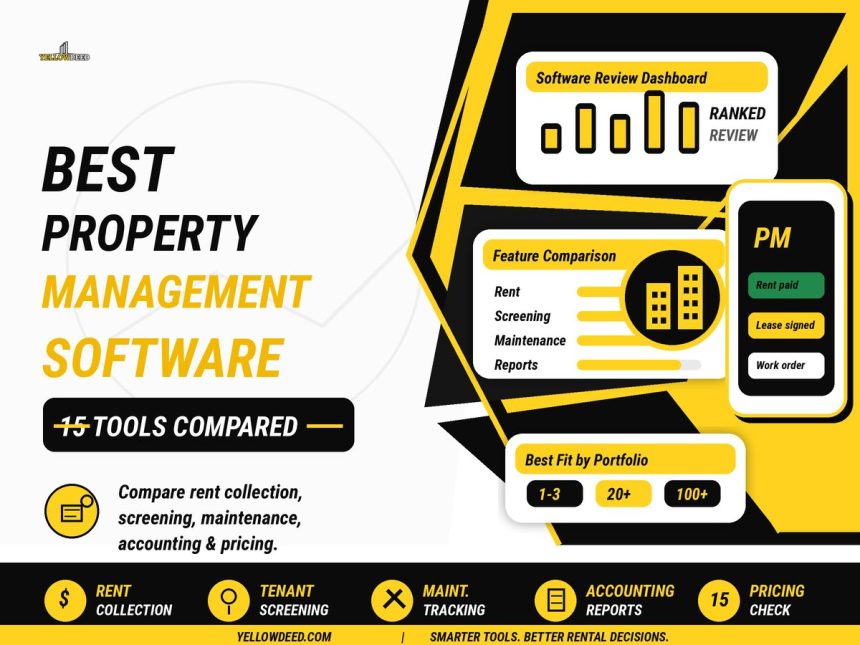
The best property management software in 2026 depends less on the “best overall” label and more on your portfolio size, property type, budget, and management style.
A solo landlord with one single-family rental does not need the same software as a property management company handling 500 units. A small landlord may need online rent collection, tenant screening, lease storage, and simple accounting. A professional manager may need owner portals, trust accounting, maintenance workflows, reporting, CAM reconciliation, inspections, integrations, and team permissions.
That is why most generic “top 10” lists are frustrating. They mix free landlord tools, enterprise platforms, accounting apps, and leasing software as if they serve the same buyer. They do not.
This guide ranks the best property management software by real use case. It looks at pricing, key features, rent collection, tenant screening, maintenance tracking, accounting tools, tenant and owner portals, mobile apps, learning curve, and portfolio size. Prices and feature sets change often, so treat all pricing as a starting point and verify current plans before buying.
Best property management software in 2026: at-a-glance rankings
Best property management software in 2026
A quick, creative comparison block for readers who want the useful details fast: best fit, pricing style, core features, pros, cons, who should avoid each platform, and direct links to each software website.
Buildium
Best overall for growing residential property management portfolios
Buildium is the safest all-around pick for growing residential portfolios that need rent collection, accounting, maintenance, leasing, tenant portals, owner portals, and reporting in one platform.
Pros
- Strong accounting and financial reporting for residential managers.
- Good mix of rent collection, maintenance, leasing, and portals.
- More scalable than free landlord tools.
Cons
- May be too much software for one or two rental units.
- Some workflows take time to learn after spreadsheets.
- Higher tiers may be needed for deeper functionality.
Who should not use it: Solo landlords who only need free listings, rent collection, and basic expense tracking.
DoorLoop
Best modern all-in-one platform for landlords and property managers
DoorLoop is a strong option when you want clean UI, faster setup, and wide property management coverage without the older enterprise-software feel.
Pros
- Cleaner interface than many older property management tools.
- Good all-in-one coverage for rent, maintenance, accounting, and portals.
- Helpful for teams moving away from spreadsheets.
Cons
- Can be more expensive than free landlord software.
- Plan details should be checked carefully before purchase.
- May be more than needed for very small portfolios.
Who should not use it: Landlords who only need a free tenant screening and rent collection starter tool.
AppFolio
Best for professional managers and large portfolios
AppFolio is built for professional property management companies that need scale, automation, AI-assisted workflows, accounting, owner reporting, and operational control.
Pros
- Strong platform for larger property management companies.
- Supports complex workflows, automation, and team operations.
- Good fit for residential, multifamily, mixed, and professional portfolios.
Cons
- Pricing is less transparent because it usually requires a quote.
- Too heavy for small DIY landlords.
- Implementation can require more planning and training.
Who should not use it: Small landlords with fewer than 20 units or anyone looking for a simple free tool.
Yardi Breeze
Best simple Yardi option for small-to-mid portfolios
Yardi Breeze is a practical option for teams that want the trust of Yardi without the enterprise complexity of Yardi Voyager.
Pros
- More approachable than Yardi Voyager.
- Supports residential, commercial, and mixed property types.
- Good fit for teams that may grow into deeper Yardi tools.
Cons
- Minimum monthly fees can be high for very small landlords.
- Advanced features may require Breeze Premier or add-ons.
- Not as simple as free small-landlord platforms.
Who should not use it: Owners with one to five units who do not need the Yardi ecosystem.
Yardi Voyager
Best enterprise property management platform
Yardi Voyager is an enterprise-grade solution for large, complex, institutional, commercial, residential, and mixed real estate portfolios.
Pros
- Powerful enough for large and complex portfolios.
- Deep accounting, reporting, compliance, and operational tools.
- Strong option for institutional real estate teams.
Cons
- Too complex for small landlords and simple portfolios.
- Requires training, setup, and internal process discipline.
- Pricing and implementation are not quick-start friendly.
Who should not use it: Small landlords or new property managers who need quick, simple setup.
Rent Manager
Best for customization and complex workflows
Rent Manager is best for property management companies that need custom workflows, integrations, work orders, reporting, and operational flexibility.
Pros
- Very customizable compared with many property management platforms.
- Strong for work orders, reporting, accounting, and integrations.
- Useful for companies with specific operational processes.
Cons
- Flexibility can create a steeper learning curve.
- Not ideal for small landlords who need a simple tool.
- Pricing requires deeper vendor evaluation.
Who should not use it: Small portfolio owners who do not need API access or custom workflows.
Rentec Direct
Best accounting-heavy platform for mid-size portfolios
Rentec Direct is a practical choice for landlords and property managers who want strong accounting, reporting, rent collection, portals, and maintenance tools without enterprise pricing.
Pros
- Strong accounting and reporting for the price point.
- Good portals and practical rental management tools.
- Transparent pricing is easier to evaluate.
Cons
- Interface may feel less modern than newer platforms.
- Can be too structured for very small landlords.
- Not as enterprise-grade as AppFolio, Voyager, or Rent Manager.
Who should not use it: Landlords with one or two units who only need free rent collection and simple records.
Hemlane
Best for DIY landlords who want software plus service help
Hemlane is a good fit for landlords who want to stay involved but need extra help with leasing, rent collection, maintenance coordination, and repair workflows.
Pros
- Combines software with useful landlord support services.
- Good for remote owners or busy DIY landlords.
- Helpful for leasing, repair coordination, and tenant workflows.
Cons
- Service layers can make it more expensive than basic software.
- Not the deepest accounting platform.
- May be unnecessary if you already use a full-service property manager.
Who should not use it: Owners who only need simple bookkeeping or already outsource full management.
Baselane
Best for banking, bookkeeping, and rental cash flow
Baselane is a finance-first platform for landlords who want property banking, bookkeeping, rent collection, and cleaner cash flow tracking.
Pros
- Strong for separating rental finances by property.
- Useful free plan for smaller landlords.
- Good cash flow and bookkeeping angle for investors.
Cons
- Not as strong for full operational property management.
- Maintenance and owner reporting are not its main strength.
- May be outgrown by larger property management companies.
Who should not use it: Professional property managers who need owner portals, staff workflows, and deeper operations.
Landlord Studio
Best accounting-first tool for small landlords
Landlord Studio is ideal for small landlords who want to replace spreadsheets with rental accounting, expense tracking, rent tracking, and tax-ready reporting.
Pros
- Affordable and easy to use for small landlords.
- Strong income, expense, mileage, and tax tracking.
- Good step up from spreadsheets.
Cons
- Not designed for large property management teams.
- Owner portals and advanced workflows are limited.
- Operational tools are lighter than Buildium or DoorLoop.
Who should not use it: Large portfolios that need advanced owner reporting, portals, and team workflows.
RentRedi
Best mobile-first software for small landlords
RentRedi is a strong mobile-first platform for landlords who want rent collection, tenant screening, lease management, maintenance requests, and flat pricing.
Pros
- Flat pricing can be attractive as unit count grows.
- Good mobile experience for landlords and tenants.
- Covers common DIY landlord workflows.
Cons
- Accounting depth is not as strong as heavier platforms.
- Not ideal for professional managers with owner reporting needs.
- May require add-ons or integrations for deeper workflows.
Who should not use it: Companies needing advanced trust accounting, owner portals, or enterprise customization.
TurboTenant
Best free marketing and tenant screening starter
TurboTenant is one of the best free options for listing rentals, receiving applications, screening tenants, building leases, and setting up online rent collection.
Pros
- Strong free starting point for solo landlords.
- Useful for marketing vacancies and screening tenants.
- Easy to start without a monthly subscription.
Cons
- Advanced features may require paid upgrades.
- Accounting and reporting are lighter than pro platforms.
- Not built for large property management operations.
Who should not use it: Managers who need deep accounting, owner portals, or large-portfolio reporting.
Avail
Best free landlord software for DIY rental management
Avail is a beginner-friendly platform for DIY landlords who want listings, applications, tenant screening, leases, rent collection, and communication tools.
Pros
- Easy starting point for new landlords.
- Free plan helps owners test structured management tools.
- Good coverage for listings, leases, screening, and payments.
Cons
- Advanced functionality may require paid upgrades.
- Not ideal for complex portfolios or owner reporting.
- Accounting depth is lighter than dedicated finance tools.
Who should not use it: Large portfolios or managers who need enterprise-grade reporting and workflows.
Stessa
Best free accounting and rental finance tracker
Stessa is best for landlords and investors who want rental accounting, cash flow tracking, banking, expense organization, and tax-ready reports.
Pros
- Excellent for cash flow and expense tracking.
- Useful free plan for real estate investors.
- Strong tax-season organization.
Cons
- Not a full operational property management system.
- Maintenance and tenant communication tools are lighter.
- Not ideal for professional managers handling multiple owners.
Who should not use it: Managers whose main problem is maintenance coordination, owner portals, or leasing workflows.
Innago
Best free all-in-one for small landlords
Innago is a serious free property management software option for small landlords who want rent collection, lease signing, screening, maintenance, and communication in one place.
Pros
- Free for landlords and property managers.
- Covers the core small-landlord feature set.
- Good alternative to paid starter platforms.
Cons
- May not match paid enterprise tools for depth and support.
- Advanced reporting and owner workflows are limited.
- Larger portfolios may eventually outgrow it.
Who should not use it: Large property management companies needing advanced accounting, reporting, and staff workflows.
| Rank | Software | Best for | Pricing snapshot | Main strength |
|---|---|---|---|---|
| 1 | Buildium | Best overall for growing residential portfolios | Starts at $62/month | Strong feature set, accounting, portals, leasing |
| 2 | DoorLoop | Best modern all-in-one platform | Starts around $69/month | Clean UI, fast setup, broad features |
| 3 | AppFolio | Best for professional managers and large portfolios | Quote-based | Scalable platform, automation, AI-first positioning |
| 4 | Yardi Breeze | Best simple Yardi option for small-to-mid portfolios | Residential starts at $1/unit/month with $100 minimum | Trusted Yardi ecosystem without Voyager complexity |
| 5 | Rent Manager | Best customizable platform | Quote/bundle-based | Deep customization and integrations |
| 6 | Rentec Direct | Best for accounting-heavy mid-size portfolios | Starts at $45/month | Strong accounting and owner/tenant portals |
| 7 | Hemlane | Best for landlords who want software plus service help | Paid plans start at $30/month | Leasing, rent collection, and repair coordination |
| 8 | Baselane | Best for banking and bookkeeping | Free plan; Core listed at $20/month | Banking, bookkeeping, rent collection |
| 9 | Landlord Studio | Best accounting-first tool for small landlords | Free plan; Pro starts at $12/month | Rental accounting and tax reporting |
| 10 | RentRedi | Best mobile-first software for small landlords | Flat pricing starting around $29.95/month monthly or lower annual equivalent | Unlimited units on flat pricing |
| 11 | TurboTenant | Best free marketing and tenant screening starter | Free plan; paid upgrades available | Listing syndication, applications, screening |
| 12 | Avail | Best free landlord software for DIY rental management | Free Unlimited plan; paid upgrade available | Listings, leases, screening, rent collection |
| 13 | Stessa | Best free accounting and rental finance tracker | Free Essentials; paid plans start at $12/month | Cash flow, banking, expenses, tax prep |
| 14 | Innago | Best free all-in-one for small landlords | Free for landlords and property managers | Rent collection, leases, screening, maintenance |
| 15 | Yardi Voyager | Best enterprise real estate platform | Custom pricing | Complex enterprise portfolios |
How we evaluated the software
This is a buyer-side review, not a vendor pitch. The property management software SERP is full of vendor-written listicles, which is not always bad, but it does create bias. AppFolio, Hemlane, Baselane, DoorLoop, and other vendors all publish software rankings where their own products naturally appear in strong positions.
For this review, the software was evaluated using public pricing pages, product feature pages, review-hub signals, portfolio fit, and practical buying criteria. Gartner’s property management software category shows that tools in this space are commonly evaluated around leasing, resident management, accounting, payments, communications, maintenance, reporting, and tenant or owner workflows. G2 also frames property management software around property type, task automation, tenant portals, and operational fit.
The ranking criteria were:
- Portfolio size fit
- Residential, commercial, or mixed portfolio support
- Online rent collection and payment processing
- Tenant screening
- Lease management and e-signature
- Maintenance request tracking
- Accounting and financial reporting
- Owner portals and tenant portals
- Mobile app quality
- Pricing transparency
- Setup effort and learning curve
- Suitability for small landlords vs. professional property managers
Affiliate disclosure: this review is written as an independent buyer guide. No software is ranked because of a paid placement.
What is property management software?
Property management software is a platform that helps landlords, property managers, and real estate investors manage rental operations from one place.
At a basic level, it may help you collect rent, list vacancies, screen tenants, store leases, track expenses, and respond to maintenance requests. At a higher level, it can handle trust accounting, owner statements, vendor coordination, inspections, automated late fees, resident communication, financial reporting, insurance tracking, and portfolio analytics.
Good property management software reduces manual work. Great property management software also improves decision-making. It tells you which units are late, which leases are expiring, which maintenance issues are open, which properties are cash-flowing, and which expenses need attention.
The right software should make your rental business easier to manage. It should not turn into another job.
The right answer depends on portfolio size
Before choosing property management software, start with your portfolio size.
| Portfolio size | Best software type | Good options |
|---|---|---|
| 1–3 units | Free or low-cost landlord software | TurboTenant, Innago, Avail, Stessa, Landlord Studio |
| 4–20 units | Low-cost paid landlord software | Baselane, RentRedi, Hemlane, Landlord Studio |
| 20–100 units | Pro property management software | Buildium, DoorLoop, Yardi Breeze, Rentec Direct |
| 100+ units | Professional manager / enterprise software | AppFolio, Yardi Breeze Premier, Rent Manager, Yardi Voyager |
| 1,000+ units | Enterprise platform | Yardi Voyager, AppFolio, Rent Manager |
This matters because many platforms have minimum monthly fees. A tool that looks affordable at $1 per unit per month can become expensive if there is a $100, $280, or $400 minimum monthly fee.
A landlord with two units should avoid paying for enterprise-grade workflows. A property management company with 300 doors should avoid free software that cannot support staff roles, reporting, owner portals, and accounting depth.
Other tools worth mentioning
TenantCloud
TenantCloud is an all-in-one platform that helps owners list properties, collect rent, and screen tenants. It may fit landlords who want a scalable landlord platform with accounting, payments, and tenant communication.
Zillow Rental Manager
Zillow Rental Manager is useful for listings, tenant screening, and online rent collection. Zillow says rent collection is free for landlords and free for tenants using ACH, while debit and credit cards carry a fee.
RentSpree
RentSpree is best viewed as a tenant screening and rental workflow tool, not a full property management platform. RentSpree says landlords can collect recurring rent payments with a $3 processing fee per recurring rent payment, while renters can use free ACH bank transfers or credit/debit cards with fees.
Feature comparison: what each platform does best
| Software | Rent collection | Tenant screening | Maintenance | Accounting | Portals | Best use |
|---|---|---|---|---|---|---|
| Buildium | Strong | Strong | Strong | Strong | Tenant + owner | Growing residential portfolios |
| DoorLoop | Strong | Strong | Strong | Strong | Tenant + owner | Modern all-in-one |
| AppFolio | Strong | Strong | Strong | Strong | Resident + owner | Professional managers |
| Yardi Breeze | Strong | Strong | Strong | Strong | Resident + owner | Small-to-mid Yardi users |
| Yardi Voyager | Strong | Strong | Strong | Enterprise | Enterprise | Institutional portfolios |
| Rent Manager | Strong | Strong | Strong | Strong | Strong | Custom workflows |
| Rentec Direct | Strong | Strong | Good | Strong | Tenant + owner | Accounting-heavy operations |
| Hemlane | Strong | Strong | Strong with service tiers | Basic to moderate | Tenant | DIY plus service help |
| Baselane | Strong | Screening available | Basic | Strong | Tenant payments | Banking/bookkeeping |
| Landlord Studio | Good | Good | Good | Strong | Basic | Small landlord accounting |
| RentRedi | Strong | Strong | Strong | Moderate | Tenant | Mobile-first landlords |
| TurboTenant | Strong | Strong | Basic | Basic | Tenant | Free leasing starter |
| Avail | Good | Good | Basic | Basic | Tenant | DIY free tools |
| Stessa | Good | Some tools | Basic | Strong | Limited | Investor finance tracking |
| Innago | Good | Good | Good | Basic to moderate | Tenant | Free all-in-one |
Pricing comparison: what you may actually pay
Property management software pricing usually follows one of four models:
- Free plan with paid add-ons: TurboTenant, Innago, Avail, Stessa, Landlord Studio
- Flat monthly fee: RentRedi, some Landlord Studio tiers, some small-landlord tools
- Per-unit pricing with minimum fee: Yardi Breeze, AppFolio-style professional platforms, some larger systems
- Custom quote: AppFolio, Rent Manager, Yardi Voyager, enterprise platforms
The hidden cost is the minimum monthly fee. A $1/unit/month platform sounds cheap, but not if there is a $100 or $400 minimum and you only manage a few units. A flat-fee platform can be cheaper for growing landlords, while per-unit pricing can be fairer if your portfolio size matches the platform’s target buyer.
Also check setup fees, onboarding fees, payment processing fees, screening fees, e-signature fees, QuickBooks integration, premium support, and migration costs.
Key features to look for when choosing property management software
Online rent collection
Online rent collection is no longer optional for most landlords. Look for ACH, debit, credit card, auto-pay, rent reminders, late fees, deposit timing, and payment processing costs.
Tenant screening
Tenant screening should include credit, background, eviction, income, and rental history where legally allowed. Be careful with AI-powered tenant screening. Fair housing compliance matters. An AI tenant screening tool, SafeRent, agreed to change scoring practices after a discrimination lawsuit involving voucher users, which is a reminder that landlords should not blindly rely on automated screening scores.
Maintenance tracking
Good maintenance tools let tenants submit requests, upload photos, communicate with managers, and track status. Stronger platforms support vendor coordination, work orders, approvals, and maintenance reporting.
Accounting and financial reporting
At minimum, look for income and expense tracking, bank feeds, categories, reports, owner statements, and tax exports. Professional property managers may need trust accounting, 1099s, balance sheets, P&L reporting, and audit-friendly records.
Lease management and e-signature
Modern property management software should store lease documents, track expiration dates, support renewals, and ideally provide e-signature tools.
Tenant and owner portals
Tenant portals help with rent payments, maintenance requests, documents, and communication. Owner portals matter if you manage properties for other owners and need to share statements, reports, and documents.
Mobile app
If you manage properties in the field, a mobile app matters. Landlords and property managers need to log maintenance, upload photos, message tenants, and check payment status from anywhere.
Integrations
Common integrations include QuickBooks, Zillow, payment processors, screening providers, insurance tools, document signing, maintenance vendors, and CRM systems. Larger operators may need API access.
AI and automation
AI-powered features are becoming more common in 2026, especially for communications, accounting workflows, maintenance routing, leasing follow-ups, and reporting. AppFolio, Rent Manager, and other platforms are actively positioning around AI and workflow automation.
Use AI carefully, especially around tenant screening, rent pricing, and fair housing compliance.
Best picks by portfolio size
Best for solo landlords with 1–3 units
Choose TurboTenant, Innago, Avail, Stessa, or Landlord Studio. These platforms keep costs low and cover basic rent collection, tenant screening, leases, and accounting.
Best for small landlords with 4–20 units
Choose Baselane if banking and bookkeeping are your priority. Choose RentRedi if you want mobile-first property management software with flat pricing. Choose Hemlane if you want help with leasing and maintenance. Choose Landlord Studio if accounting is the main problem.
Best for 20–100 units
Choose Buildium, DoorLoop, Rentec Direct, or Yardi Breeze. This is where free tools often start to feel limiting. You need better reporting, automation, portals, accounting, and maintenance tracking.
Best for 100+ units
Choose AppFolio, Yardi Breeze Premier, Rent Manager, or Yardi Voyager. At this size, setup time and pricing matter less than operational control, team workflows, reporting, and scalability.
Best for commercial or mixed portfolios
Start with Yardi Breeze, Yardi Voyager, Rent Manager, or AppFolio. Commercial and mixed portfolios need stronger lease management, accounting, reporting, and custom workflows than most small-landlord tools provide.
Worked recommendation by portfolio type
Scenario 1: one single-family rental
Use TurboTenant, Innago, Avail, Stessa, or Landlord Studio. You do not need enterprise software. Focus on tenant screening, online rent payments, lease storage, and basic accounting.
Scenario 2: eight units managed by the owner
Use Baselane for banking and bookkeeping, RentRedi for mobile-first operations, or Landlord Studio for accounting and reporting. Hemlane is useful if you want service help.
Scenario 3: 25 residential units
Use DoorLoop, Buildium, Rentec Direct, or Yardi Breeze. At 25 units, maintenance tracking, reporting, tenant communication, and rent collection become harder to handle manually.
Scenario 4: 200 mixed units
Use AppFolio, Rent Manager, Yardi Breeze Premier, or Yardi Voyager. You likely need owner reporting, staff permissions, strong accounting, maintenance workflows, and deeper integrations.
Scenario 5: 1,000+ enterprise units
Use Yardi Voyager, AppFolio, or Rent Manager. At this level, the buying process should include demos, security review, data migration planning, training, implementation timeline, and accounting validation.
Common mistakes when buying property management software
Choosing by brand name only
The most famous software is not always the best fit. AppFolio and Yardi are powerful, but they are not always right for small landlords.
Ignoring minimum monthly fees
Always calculate the real cost for your unit count. A $100 minimum fee may be fine for 100 units and expensive for five units.
Underestimating data migration
Switching from spreadsheets or old software takes time. You need leases, tenants, balances, owner data, maintenance records, documents, bank accounts, and property details moved accurately.
Buying too much software too early
Small landlords often overbuy. Start with what solves your current pain: rent collection, screening, accounting, or maintenance.
Buying too little software when you manage owners
If you manage properties for other owners, free landlord tools usually are not enough. You need owner portals, statements, reporting, and clean accounting.
Not checking payment fees
Online payments can include ACH fees, card fees, processing delays, and tenant-paid charges. These fees matter at scale.
Ignoring fair housing risks
Be careful with tenant screening, AI tools, and automated decision-making. Software can help organize data, but landlords and managers still need compliant policies.
FAQs about property management software
What is the best property management software for small landlords?
For small landlords, the best property management software is usually TurboTenant, Innago, Avail, Stessa, Landlord Studio, RentRedi, Baselane, or Hemlane. The right choice depends on whether you need leasing, accounting, rent collection, maintenance, or service help.
What is the best free property management software?
Innago, TurboTenant, Avail, Stessa, and Landlord Studio all have strong free or low-cost options. Innago is a strong free all-in-one choice, while Stessa is best for free accounting and investor tracking.
How much does property management software cost?
Property management software can cost $0/month for free landlord tools, $12–$80/month for small-landlord platforms, $45–$300/month for mid-size software, and custom pricing for enterprise platforms. Some tools charge per unit, while others use flat monthly pricing.
Is AppFolio better than Buildium?
AppFolio is usually better for larger professional property management companies that need scale and automation. Buildium is often better for small-to-mid residential managers who want strong features with more transparent starting pricing.
Is DoorLoop good for small landlords?
DoorLoop can be good for small landlords who want an all-in-one paid platform, but it may be more than needed for one to three units. Free tools may be enough at that stage.
What is the difference between Yardi Breeze and Yardi Voyager?
Yardi Breeze is the simpler, more accessible Yardi platform for small-to-mid portfolios. Yardi Voyager is the enterprise platform for large and complex portfolios.
Can I use QuickBooks instead of property management software?
You can use QuickBooks for accounting, but it does not replace tenant portals, maintenance tracking, lease management, rent collection workflows, owner portals, or property-specific automation. Many landlords eventually need both accounting and property management workflows.
What features should I look for?
Look for online rent collection, tenant screening, maintenance tracking, accounting, reporting, lease management, e-signature, document storage, tenant portals, owner portals, mobile access, and integrations.
Is property management software worth it for 1–5 units?
Yes, but you probably do not need expensive software. Free or low-cost tools can help with rent collection, tenant screening, lease storage, and expense tracking.
Can tenants pay rent through these platforms?
Yes. Most property management software platforms now include online rent payments or integrate with payment tools. Check ACH fees, card fees, payment timing, and whether the landlord or tenant pays the fee.
How long does it take to set up property management software?
A small landlord can often set up free or simple software in a day. A property management company may need several weeks for data migration, accounting setup, training, and portal rollout.
Can I switch property management software later?
Yes, but data migration is the hard part. Before switching, export leases, tenant records, payment history, maintenance logs, owner data, documents, and financial reports.
Do these tools handle commercial properties?
Some do. Yardi Breeze, Yardi Voyager, AppFolio, Rent Manager, and certain other professional platforms support commercial or mixed portfolios better than small-landlord tools.
What is new in property management software for 2026?
The biggest 2026 trends are AI-powered workflows, better automation, stronger mobile tools, banking integrations, faster rent collection, smarter maintenance routing, and more attention to fair housing risk in tenant screening.
Final verdict: which property management software should you choose?
Choose the software that fits your current portfolio and the next stage of growth.
For one to three units, start with free tools like TurboTenant, Innago, Avail, Stessa, or Landlord Studio. For four to 20 units, look at Baselane, RentRedi, Landlord Studio, and Hemlane. For 20 to 100 units, Buildium, DoorLoop, Rentec Direct, and Yardi Breeze are stronger choices. For 100+ units or professional property management companies, look at AppFolio, Rent Manager, Yardi Breeze Premier, and Yardi Voyager.
The best property management software is not the one with the longest feature list. It is the one that removes the most friction from your rental business without adding cost, complexity, or workflows you do not need.