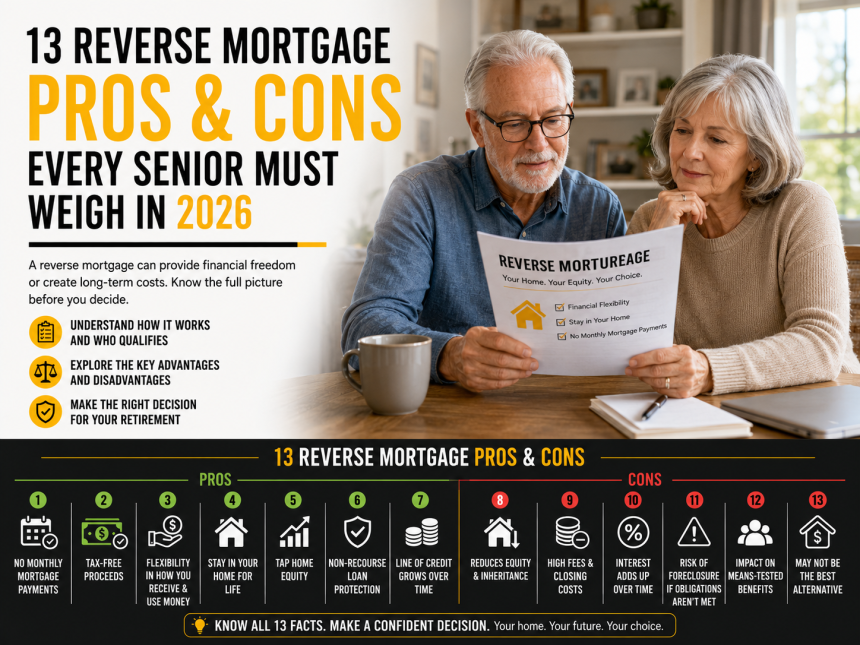
A reverse mortgage is a home loan available to homeowners aged 62 and older that converts a portion of accumulated home equity into cash without requiring monthly mortgage payments. The loan balance grows over time and becomes due when the borrower sells the home, moves out permanently, or passes away.
- What Is a Reverse Mortgage and How Does It Work?
- Who Qualifies for a Reverse Mortgage in 2026?
- 1. Pro: No Monthly Mortgage Payments Required
- 2. Pro: Tax-Free Proceeds
- 3. Pro: Flexibility in How You Receive and Use the Money
- 4. Pro: You Retain Title and Can Stay in the Home
- 5. Pro: Non-Recourse Protection for Borrowers and Heirs
- 6. Pro: Can Delay Drawing Down Retirement Investments
- 7. Con: High Upfront and Ongoing Costs
- 8. Con: Loan Balance Grows Over Time
- 9. Con: Reduces or Eliminates the Inheritance You Leave Behind
- 10. Con: Mandatory Obligations That Can Trigger Default
- 11. Con: Complexity of the Loan Terms and Maturity Events
- 12. Con: Limits Future Housing Flexibility
- 13. Con: Risk of Scams Targeting Seniors
- Reverse Mortgage Pros and Cons for Seniors: Summary Table
- Is a Reverse Mortgage Right for You? Deciding Factors
- Alternatives to a Reverse Mortgage Worth Considering
The reverse mortgage pros and cons of this product are not equally balanced for everyone. For some seniors it solves a real retirement income problem. For others, it erodes the estate they planned to leave behind or creates obligations their heirs are not prepared to handle. Understanding both sides clearly is the only way to make a decision that holds up over time.
This guide covers what a reverse mortgage is, how it actually works, who qualifies, all 13 major pros and cons, and a practical framework for deciding whether this product fits your situation in 2026.
What Is a Reverse Mortgage and How Does It Work?
A reverse mortgage is a federally regulated loan product that allows eligible homeowners to borrow against the equity in their primary residence without selling the home or making monthly principal and interest payments. The most common type is the Home Equity Conversion Mortgage, or HECM, which is insured by the Federal Housing Administration and governed by the U.S. Department of Housing and Urban Development.
Unlike a traditional mortgage, where the borrower’s balance decreases with each payment, a reverse mortgage balance increases over time as interest accrues and is added to the loan. The lender makes payments to the borrower, not the other way around, until the loan becomes due.
Proceeds can be received as a lump sum, a line of credit, fixed monthly payments, or a combination of those options. There are no income taxes owed on reverse mortgage proceeds because the IRS treats them as loan advances, not income.
The loan does not require repayment until the last borrower leaves the home. At that point, the heirs or the estate have several options: sell the home and pay off the loan, refinance into a conventional mortgage to keep the property, or walk away and let the lender take the home. Because HECM loans are non-recourse, heirs are never required to pay more than the home is worth, even if the loan balance has grown larger than the property value.
Who Qualifies for a Reverse Mortgage in 2026?
Reverse mortgage eligibility is straightforward but non-negotiable. Meeting every requirement is necessary before any application can proceed.
The core qualification criteria include:
- At least one borrower must be 62 years of age or older
- The property must be the borrower’s primary residence, occupied for the majority of the year
- The borrower must have sufficient equity in the home (no minimum equity percentage is codified, but most lenders require at least 50%)
- The borrower must be current on, or able to pay, property taxes, homeowner’s insurance, and any HOA fees
- The property must meet FHA condition standards, which may require repairs before approval
- The borrower must complete a HUD-approved reverse mortgage counseling session before the loan can be processed
Eligible property types include single-family homes, 2-to-4 unit properties with one unit occupied by the borrower, FHA-approved condominiums, and manufactured homes that meet HUD standards. Second homes, investment properties, and vacation homes do not qualify.
For 2026, the HECM lending limit is $1,209,750, which is the maximum appraised value the FHA will use to calculate your available proceeds regardless of the home’s actual market value. Homeowners with properties valued above this threshold may be better served by a proprietary jumbo reverse mortgage, which can accommodate loan amounts up to $4 million at some lenders.
1. Pro: No Monthly Mortgage Payments Required
The most immediate financial benefit of a reverse mortgage is the elimination of required monthly principal and interest payments to the lender. For seniors on fixed incomes, removing a $1,200 or $1,800 monthly mortgage obligation can meaningfully improve cash flow and reduce financial stress.
It is worth being precise about what this means. Borrowers are still fully responsible for property taxes, homeowner’s insurance, HOA dues if applicable, and routine home maintenance. Failure to keep current on any of these obligations is a default condition that can trigger the loan to become due. The elimination of the mortgage payment is real, but it does not eliminate all housing costs.
For retirees whose primary financial pressure is the gap between monthly income and monthly obligations, this benefit alone can justify exploring a reverse mortgage further.
2. Pro: Tax-Free Proceeds
Reverse mortgage proceeds are not considered taxable income by the IRS. Whether you receive a lump sum at closing, monthly disbursements, or draws from a line of credit, those funds are treated as loan advances rather than earned income, and they do not affect your taxable income for the year.
This distinction matters for Social Security recipients and for seniors who are managing income levels carefully to stay within specific tax brackets or to preserve Medicare premium eligibility. Reverse mortgage proceeds will not increase your adjusted gross income or affect the taxation of your Social Security benefits.
One nuance worth noting: reverse mortgage proceeds can affect eligibility for means-tested government assistance programs such as Medicaid or Supplemental Security Income if funds are not spent within the calendar month they are received and accumulate as countable assets. If you receive either of these benefits, consult a benefits specialist before proceeding with a reverse mortgage.
3. Pro: Flexibility in How You Receive and Use the Money
Reverse mortgage proceeds come with no restrictions on how they can be spent. Medical bills, home modifications, travel, debt payoff, daily living expenses, or helping a family member financially are all equally permitted uses.
The disbursement options add a second layer of flexibility:
| Disbursement Option | Best Suited For |
|---|---|
| Lump sum (fixed-rate only) | Paying off an existing mortgage or large one-time expense |
| Line of credit | Irregular expenses, emergency reserve, or strategic equity preservation |
| Tenure payments | Supplementing monthly income for as long as you live in the home |
| Term payments | Predictable income for a specific number of years |
| Combination | Custom mix of immediate cash plus ongoing income or credit access |
The HECM line of credit has a feature no other home equity product offers: unused funds grow over time at the same rate as the loan’s interest rate. This means a line of credit established today will have a larger available balance in five years, regardless of what happens to the home’s market value. For seniors who open a reverse mortgage as a financial safety net before they need it, this growth feature can substantially increase the funds available when a real need arises.
4. Pro: You Retain Title and Can Stay in the Home
A common misconception is that taking a reverse mortgage means the lender owns your home. This is not accurate. Borrowers retain full title to the property for the life of the loan. The lender holds a lien against the property, the same as with any mortgage, but the homeowner remains the legal owner.
The right to remain in the home is protected as long as the borrower continues to meet the loan’s occupancy and maintenance requirements. This includes living in the home as the primary residence, keeping up with property taxes and insurance, and maintaining the property in reasonable condition.
For seniors who have lived in their home for decades and whose identity or community ties are connected to that home, the ability to access its equity without being required to leave is a significant advantage that no sale-leaseback arrangement or downsizing strategy can replicate.
5. Pro: Non-Recourse Protection for Borrowers and Heirs
HECM reverse mortgages are non-recourse loans. This means neither the borrower nor their heirs can ever owe more than the home is worth at the time of repayment, regardless of how large the loan balance has grown.
If a borrower takes out a reverse mortgage at 68, lives in the home until 91, and the accumulated loan balance exceeds the home’s appraised value at death, the FHA’s mortgage insurance fund covers the shortfall. The heirs surrender the home and walk away with no remaining obligation. No other assets, retirement accounts, or personal funds can be claimed by the lender to satisfy the balance.
This protection is funded through the mandatory mortgage insurance premium, which is built into the closing costs of every HECM. The upfront MIP is 2% of the appraised value, and an ongoing annual MIP of 0.5% is added to the loan balance each year. While this is a real cost, it purchases meaningful protection for both the borrower and the estate.
6. Pro: Can Delay Drawing Down Retirement Investments
One strategic use of a reverse mortgage that financial planners increasingly discuss is using a HECM line of credit as an alternative to selling investments during market downturns in early retirement.
The sequence-of-returns risk is one of the most damaging forces in retirement finance. When a retiree is forced to sell investments at depressed values to cover living expenses, the long-term portfolio is harmed in a way that cannot be recovered when the market rebounds. Drawing living expenses from a reverse mortgage line of credit during a down market allows the investment portfolio time to recover before resuming withdrawals.
Research published by financial planning academics has shown that integrating a HECM line of credit into a coordinated retirement income strategy can extend portfolio longevity by several years compared to a portfolio-only approach. For seniors with meaningful investment assets and a paid-off or mostly paid-off home, this strategy warrants serious consideration.
7. Con: High Upfront and Ongoing Costs
Reverse mortgages carry higher costs than most other home equity products. The combination of origination fees, closing costs, the mandatory mortgage insurance premium, and ongoing monthly servicing fees makes this one of the more expensive ways to access home equity.
Typical HECM costs include:
- Origination fee: up to $6,000 depending on home value (the greater of $2,500 or 2% of the first $200,000 of appraised value, plus 1% of value above that, capped at $6,000)
- Upfront mortgage insurance premium: 2% of the maximum claim amount
- Third-party closing costs: appraisal, title insurance, credit report, and recording fees typically totaling $2,000 to $4,000
- Monthly servicing fee: up to $35 per month added to the loan balance
- Annual MIP: 0.5% of the outstanding loan balance added each year
For a home worth $400,000, the upfront costs alone could exceed $15,000 to $18,000. Most of these can be rolled into the loan rather than paid out of pocket, but rolling costs into the loan means they accrue interest for the life of the loan.
If you are considering a reverse mortgage primarily to access a small amount of cash in the short term, the cost structure makes it a poor choice. Reverse mortgages become more cost-effective the longer the borrower remains in the home.
8. Con: Loan Balance Grows Over Time
Because no monthly payments are made, interest compounds and is added to the loan balance every month. This means the balance owed grows continuously from the day the loan closes until the day it is repaid.
The rate at which the balance grows depends on the interest rate and the disbursement method. A fixed-rate loan draws the full principal limit at closing, so interest begins accruing immediately on the entire amount. An adjustable-rate loan with a line of credit only accrues interest on funds actually drawn, which can slow balance growth significantly in the early years.
For a borrower who takes a $200,000 lump sum at a 6.5% effective interest rate, the outstanding balance will approximately double in eleven years through compounding alone. If the home appreciates at a rate that keeps pace with loan balance growth, the net equity position may be relatively stable. If home appreciation lags or stalls, the equity available at payoff diminishes substantially.
This is not a hidden risk, it is a fundamental characteristic of how reverse mortgages work. Borrowers and their families should run projections showing the expected loan balance and remaining equity at 5, 10, and 15 years before committing.
9. Con: Reduces or Eliminates the Inheritance You Leave Behind
The equity in your home may be one of the largest assets in your estate. A reverse mortgage converts that equity into spending cash over time, and what is left for heirs depends entirely on how much the home appreciates versus how fast the loan balance grows.
For seniors whose primary goal is to leave a significant financial inheritance to their children or grandchildren, a reverse mortgage works directly against that objective. The heirs will receive whatever equity remains after the loan is repaid, which may be substantially less than the home’s current value, or in a worst-case scenario, nothing at all beyond the non-recourse protection.
If leaving an inheritance is a core priority, this con alone may be determinative. An honest conversation with family members about their expectations and your financial needs is essential before any reverse mortgage decision is finalized.
10. Con: Mandatory Obligations That Can Trigger Default
While reverse mortgages eliminate required mortgage payments, they introduce a different set of mandatory obligations. Failing to meet any of them puts the loan in default and can result in the lender requiring full repayment.
The ongoing obligations that must be maintained include:
- Property taxes paid on time, in full, every year
- Homeowner’s insurance maintained continuously with required coverage levels
- The home must remain the borrower’s primary residence (absent no longer than 12 consecutive months)
- The property must be maintained in good repair and condition
- HOA dues paid current if the property is in a governed community
Property tax defaults are the most common cause of reverse mortgage foreclosure among seniors. For homeowners who are already struggling to manage these obligations, a reverse mortgage does not solve the underlying financial pressure and may accelerate it by giving a false sense of security.
11. Con: Complexity of the Loan Terms and Maturity Events
A reverse mortgage becomes due and payable upon the occurrence of what are called maturity events. Understanding all of them before closing is not optional, it is essential.
Maturity events that trigger repayment include:
- The last surviving borrower passes away
- The last surviving borrower sells or transfers the property title
- The home is no longer the primary residence for more than 12 consecutive months (including extended medical facility stays)
- The borrower fails to pay property taxes, insurance, or maintain the home
- The property falls into serious disrepair and the borrower fails to make required corrections after receiving a repair notice
For borrowers with a non-borrowing spouse, the rules changed significantly after 2015. Eligible Non-Borrowing Spouses who meet certain requirements can remain in the home after the borrower’s death without triggering immediate repayment, but they cannot draw additional funds from the loan. If your spouse is not yet 62 and will not be on the loan, understanding the exact protections and limitations for your situation requires detailed review with a HUD counselor and potentially an elder law attorney.
12. Con: Limits Future Housing Flexibility
Taking a reverse mortgage makes it more complicated and potentially expensive to move. If you decide three years after closing that you want to downsize, relocate to be near family, or move into an assisted living facility, the reverse mortgage must be paid off in full before or at the time of the move.
For borrowers who used a large lump sum at closing and whose home has not appreciated significantly, the payoff amount may be close to or exceed the current market value, leaving little net proceeds from the sale to fund the move.
Reverse mortgages work best when the borrower has a realistic expectation of remaining in the home for at least five to seven years. Shorter time horizons rarely justify the upfront costs, and the flexibility to move without financial complications decreases once a reverse mortgage is in place.
13. Con: Risk of Scams Targeting Seniors
The reverse mortgage industry has a documented history of predatory lending practices and financial elder abuse. Seniors approached by contractors, real estate investors, or financial salespeople who promote reverse mortgages as part of an investment scheme or home improvement arrangement should exercise extreme caution.
Legitimate concerns include:
- Contractors who recommend reverse mortgages to fund repairs and receive kickbacks from lenders
- Investment advisors who suggest using reverse mortgage proceeds to purchase annuities or other financial products, which is flagged by the Consumer Financial Protection Bureau as a high-risk combination
- Family members or caregivers who pressure seniors into reverse mortgages to access funds for the family’s use rather than the homeowner’s benefit
The HUD counseling requirement exists specifically to protect seniors from making uninformed decisions or being misled by parties with conflicting interests. Choose a HUD-approved counselor independently rather than using one recommended by the lender or any party with a financial interest in the transaction.
Reverse Mortgage Pros and Cons for Seniors: Summary Table
| Factor | Pro or Con | Detail |
|---|---|---|
| Monthly payments | Pro | No required principal and interest payments |
| Tax treatment | Pro | Proceeds are not taxable income |
| Disbursement flexibility | Pro | Lump sum, line of credit, monthly income, or combination |
| Home ownership | Pro | Borrower retains title for the life of the loan |
| Non-recourse protection | Pro | Heirs never owe more than home is worth |
| Portfolio strategy | Pro | Line of credit can reduce sequence-of-returns risk |
| Closing costs | Con | High upfront fees relative to other equity products |
| Compounding balance | Con | Loan balance grows continuously without payments |
| Estate reduction | Con | Reduces or eliminates home equity left to heirs |
| Ongoing obligations | Con | Taxes, insurance, and maintenance must be maintained |
| Maturity event complexity | Con | Multiple triggers can accelerate the due date |
| Housing flexibility | Con | Moving becomes more complicated and costly |
| Scam exposure | Con | Seniors are frequently targeted by predatory schemes |
Is a Reverse Mortgage Right for You? Deciding Factors
A reverse mortgage makes the most sense when several conditions are true at the same time. You have significant equity, you plan to remain in the home long enough to justify the upfront costs, monthly cash flow is genuinely constrained, inheritance is not a primary goal, and you fully understand the obligations the loan imposes.
Questions worth answering before proceeding:
- How long do you realistically plan to stay in this home?
- Would eliminating a mortgage payment or accessing equity solve a specific, defined financial problem?
- Do your heirs understand what a reverse mortgage means for the estate, and have you discussed it with them?
- Can you reliably continue paying property taxes, insurance, and maintenance costs?
- Have you explored alternatives including a HELOC, cash-out refinance, or downsizing?
A reverse mortgage is not inherently a good or bad product. It is a powerful financial tool with meaningful tradeoffs, and its appropriateness depends entirely on the individual’s situation, time horizon, and retirement priorities.
Alternatives to a Reverse Mortgage Worth Considering
Before committing to a reverse mortgage, evaluate these alternatives:
- Home equity line of credit (HELOC): Lower costs, requires income qualification and monthly interest payments, but preserves equity and offers flexibility
- Cash-out refinance: Converts equity to cash with a new conventional mortgage, requires monthly payments but at potentially lower rates than a reverse mortgage’s effective cost
- Downsizing: Selling the current home and purchasing a less expensive property frees up equity with full control over proceeds
- Renting a portion of the property: Generates income from existing assets without debt
- Social Security optimization: Delaying Social Security past full retirement age increases monthly benefit by 8% per year up to age 70, which may eliminate the income gap a reverse mortgage would otherwise fill
For a full comparison of financing options including HELOCs and cash-out refinances, see our real estate financing guide.